AI Agent Architecture
Slides + PowerPoint5 slides
Free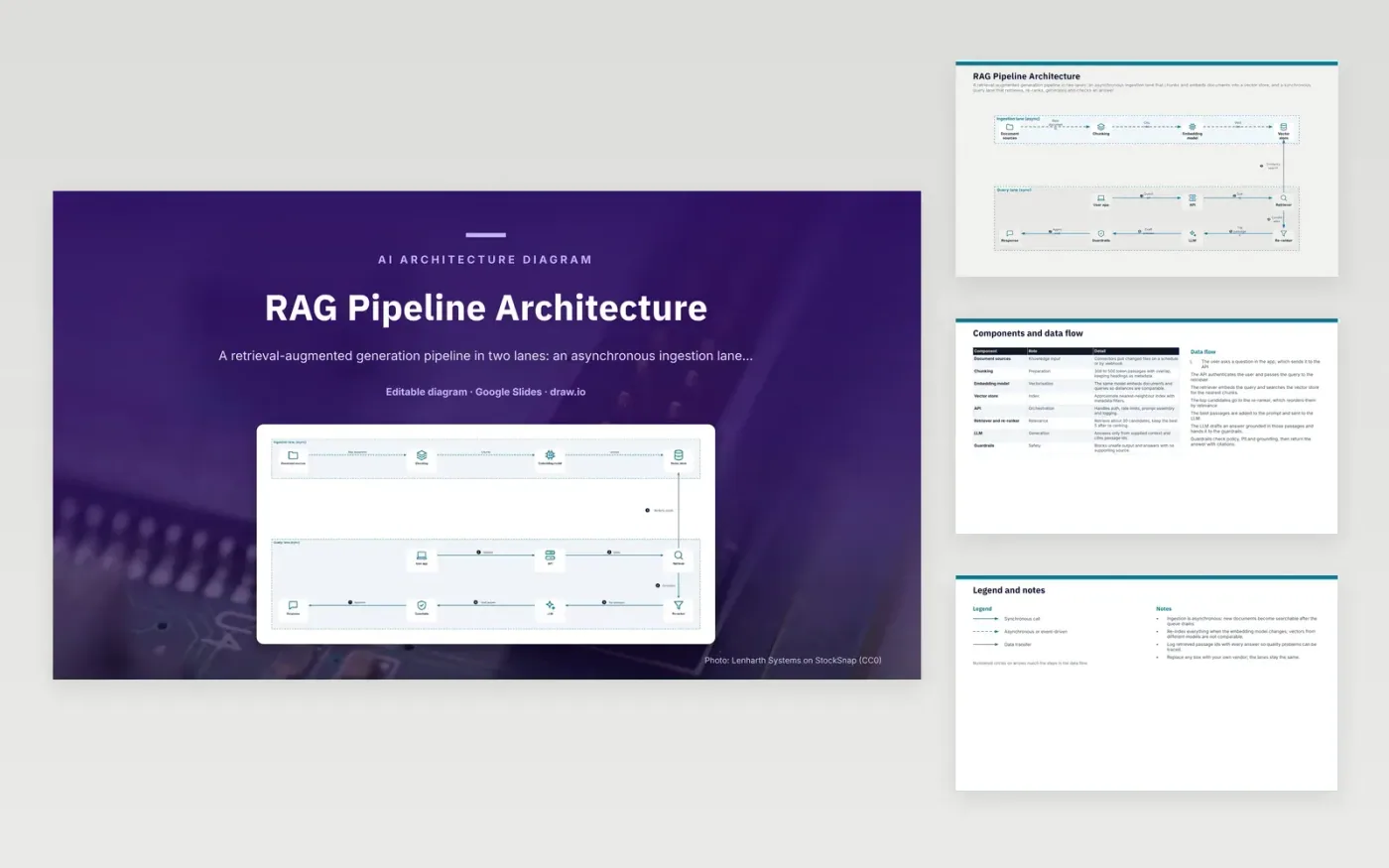
Documents from wikis, PDFs and tickets are chunked and embedded into a vector store in an asynchronous lane. When a user asks a question, the API authenticates the request and the retriever embeds the query and searches the store for the nearest chunks. The re-ranker reorders about 30 candidates and keeps the best five. The LLM drafts an answer from those passages, and guardrails check policy, PII and grounding before the answer returns with citations.
The re-ranker is the quality step: a cross-encoder reads each query and passage together, which is slower than vector distance alone but more accurate. Ingestion and querying are separate, so new documents become searchable once the queue drains. The embedding model must stay the same for documents and queries, and changing it means re-indexing everything. Logging the passage ids behind each answer makes quality problems traceable.
Click Make a copy in Google Slides, then confirm on the Google page. The copy is saved to your own Google Drive.
Rename Document sources, Chunking, Embedding model and the other boxes inside Ingestion lane (async) to your own components, and delete the ones your system does not have.
Rewrite the 7-step data flow and the 8-row components table so they match the arrows you keep.
For the draw.io version, download rag-pipeline-architecture-diagram.drawio and open it at app.diagrams.net.
Vector search returns candidates that are close in embedding space, which is fast but coarse. A cross-encoder re-ranker scores each query and passage pair directly, so the best passages reach the LLM. Here it keeps the top five from about 30 candidates.
Vectors are comparable only when they come from the same model, so a query embedded by a different model lands in a different space. Changing the model means re-embedding and re-indexing every document.
They check the draft against policy, PII rules and grounding, and block any answer that has no supporting source. The reply goes out only with the passages it cites.
More Google Slides templatesMore developer workflows templates
Slides + PowerPoint5 slides
Free
Slides + PowerPoint5 slides
Free
Slides + PowerPoint5 slides
Free
Slides + PowerPoint5 slides
Free
Slides + PowerPoint5 slides
Free
Slides + PowerPoint5 slides
Free
Slides + PowerPoint5 slides
Free
Slides + PowerPoint5 slides
Free
Slides + PowerPoint5 slides
Free
Slides + PowerPoint5 slides
Free
Slides + PowerPoint5 slides
Free