AWS Three-Tier Web Architecture
Slides + PowerPoint5 slides
Free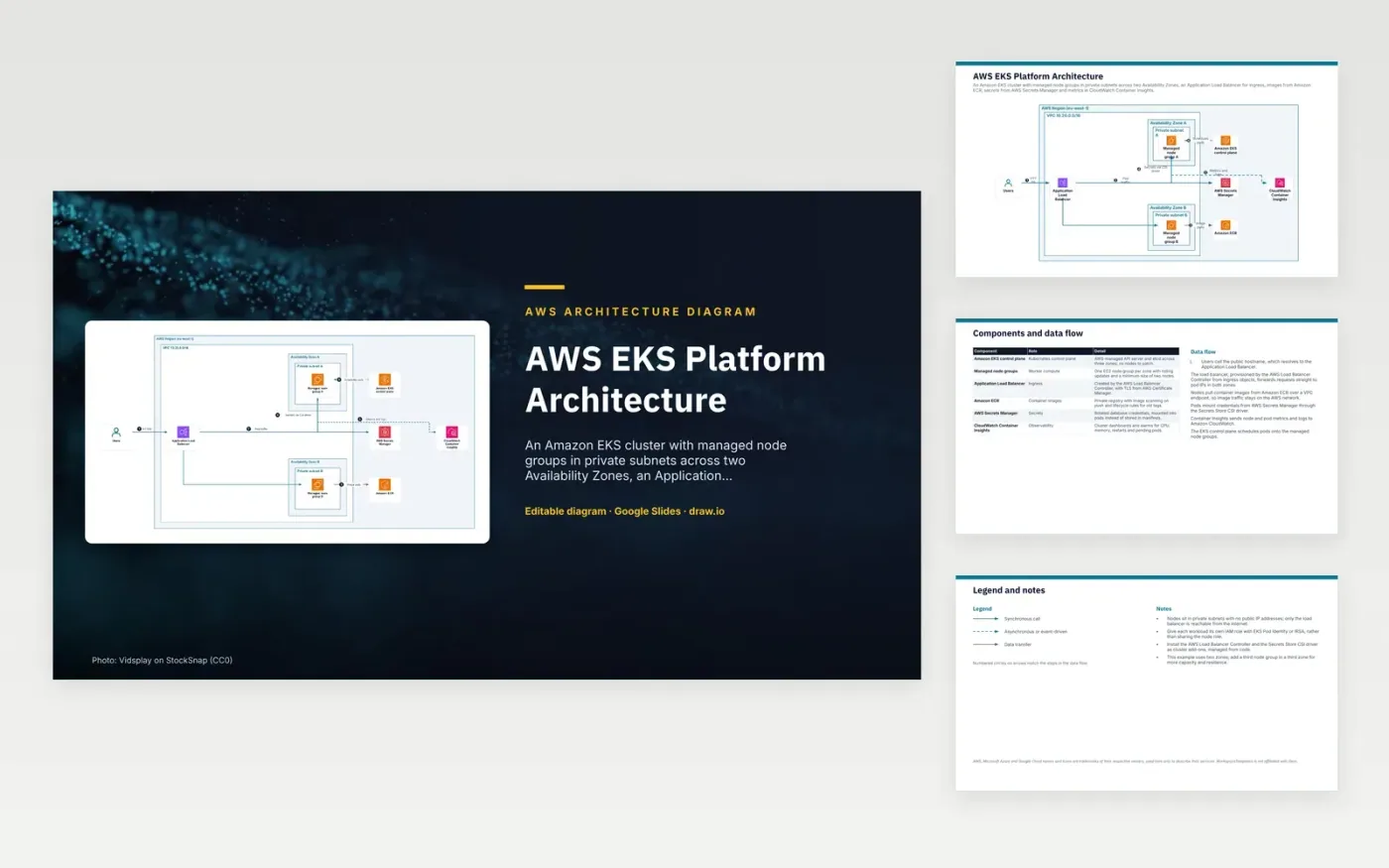
Users call a public hostname that resolves to the Application Load Balancer. The AWS Load Balancer Controller builds that load balancer from Kubernetes Ingress objects and forwards requests straight to pod IPs in both zones. Nodes in each managed node group pull images from Amazon ECR over a VPC endpoint. Pods mount database credentials from AWS Secrets Manager through the Secrets Store CSI driver. The EKS control plane schedules the pods onto the nodes.
Only the load balancer faces the internet. Nodes sit in private subnets with no public IP addresses, and each workload gets its own IAM role through EKS Pod Identity or IRSA rather than sharing the node role. The example uses two zones with a minimum of two nodes per group. To adapt it for more capacity, add a third node group in a third zone and keep the load balancer controller and CSI driver as add-ons managed from code.
The diagram uses the official AWS architecture icons, each labelled with its service name. AWS, Microsoft Azure and Google Cloud names and icons are trademarks of their respective owners, used here only to describe their services. WorkspaceTemplates is not affiliated with them.
Click Make a copy in Google Slides, then confirm on the Google page. The copy is saved to your own Google Drive.
Rename Users, Application Load Balancer, Managed node group A and the other boxes inside AWS Region (eu-west-1) to your own components, and delete the ones your system does not have.
Rewrite the 6-step data flow and the 6-row components table so they match the arrows you keep.
For the draw.io version, download aws-eks-platform-architecture-diagram.drawio and open it at app.diagrams.net.
Nodes in private subnets have no public IP addresses, so they cannot be reached directly from the internet. Only the Application Load Balancer accepts public traffic. Nodes reach ECR over a VPC endpoint, so image pulls stay on the AWS network.
Both give a pod its own AWS permissions instead of the permissions of the node it runs on. IRSA uses an OIDC provider and annotated service accounts, while EKS Pod Identity uses an agent on each node and an association between the cluster and the role.
It mounts secrets from an external store, such as AWS Secrets Manager, into a pod as a volume. Credentials then stay out of Kubernetes manifests, and the application reads them from files.
More Google Slides templatesMore developer workflows templates
Slides + PowerPoint5 slides
Free
Slides + PowerPoint5 slides
Free
Slides + PowerPoint5 slides
Free
Slides + PowerPoint5 slides
Free
Slides + PowerPoint5 slides
Free
Slides + PowerPoint5 slides
Free
Slides + PowerPoint5 slides
Free
Slides + PowerPoint5 slides
Free
Slides + PowerPoint5 slides
Free










