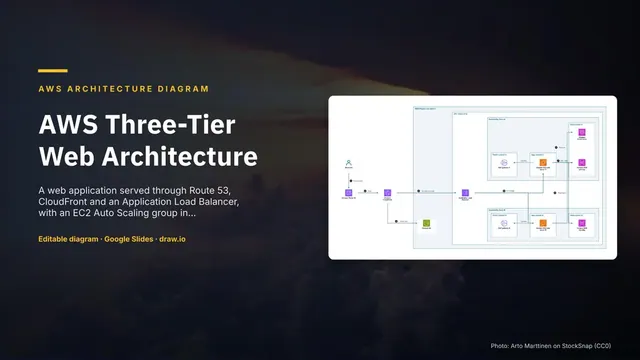
AWS Three-Tier Web Architecture
Slides + PowerPoint5 slides
Free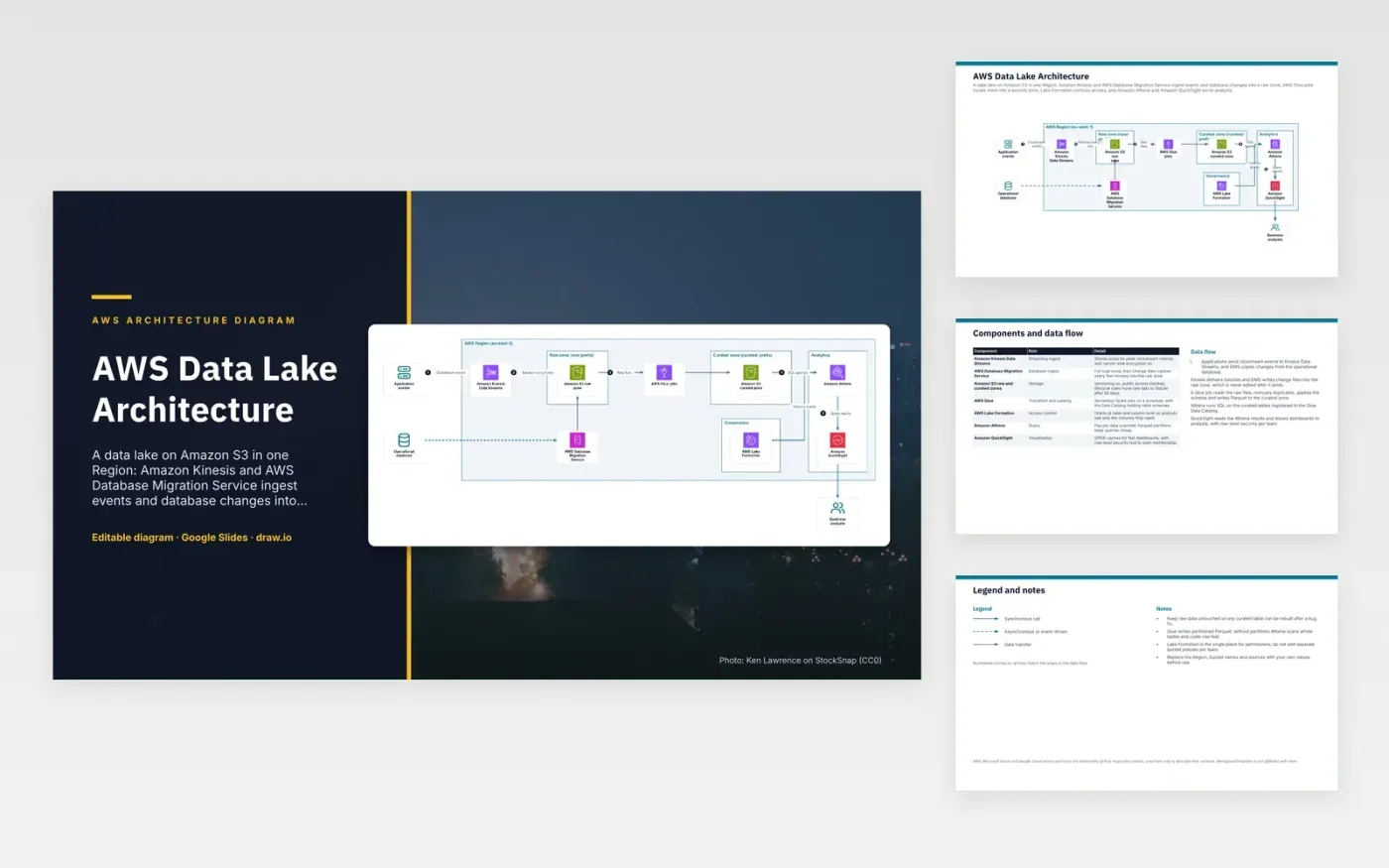
Clickstream events from applications go to Amazon Kinesis Data Streams, and changes from the operational PostgreSQL database go through AWS Database Migration Service. Both land files in the raw S3 zone, which is never edited. An AWS Glue job then removes duplicates, applies the schema and writes partitioned Parquet to the curated zone. Amazon Athena runs SQL on the curated tables, and Amazon QuickSight shows dashboards to analysts.
Lake Formation is the one place for permissions, with grants at table and column level, so analysts see only the columns they need. Keeping raw data untouched means any curated table can be rebuilt after a bug fix. Partitioned Parquet keeps Athena scans small and cheap. To adapt it, swap the sources for your own, change the Region and bucket names, and add a partition key that matches your most common filter.
The diagram uses the official AWS architecture icons, each labelled with its service name. AWS, Microsoft Azure and Google Cloud names and icons are trademarks of their respective owners, used here only to describe their services. WorkspaceTemplates is not affiliated with them.
Click Make a copy in Google Slides, then confirm on the Google page. The copy is saved to your own Google Drive.
Rename Application events, Operational database, Amazon Kinesis Data Streams and the other boxes inside AWS Region (eu-west-1) to your own components, and delete the ones your system does not have.
Rewrite the 5-step data flow and the 7-row components table so they match the arrows you keep.
For the draw.io version, download aws-data-lake-architecture-diagram.drawio and open it at app.diagrams.net.
The raw zone holds the original files exactly as they arrived. If a Glue job has a bug, the curated zone can be rebuilt from those files without asking the source systems to resend data. Lifecycle rules can then move older raw data to Glacier to save cost.
Lake Formation grants access to catalogue tables and columns, and Athena checks those grants when it runs a query. S3 bucket policies work at the level of buckets and prefixes, so they cannot limit which columns an analyst sees.
Athena charges for the data it scans. Parquet is a columnar format, so a query reads only the columns it names. Partitions let Athena skip folders that do not match the filter, so a query for one month reads only that month.
More Google Slides templatesMore developer workflows templates
Slides + PowerPoint5 slides
Free
Slides + PowerPoint5 slides
Free
Slides + PowerPoint5 slides
Free
Slides + PowerPoint5 slides
Free
Slides + PowerPoint5 slides
Free
Slides + PowerPoint5 slides
Free
Slides + PowerPoint5 slides
Free
Slides + PowerPoint5 slides
Free
Slides + PowerPoint5 slides
Free










