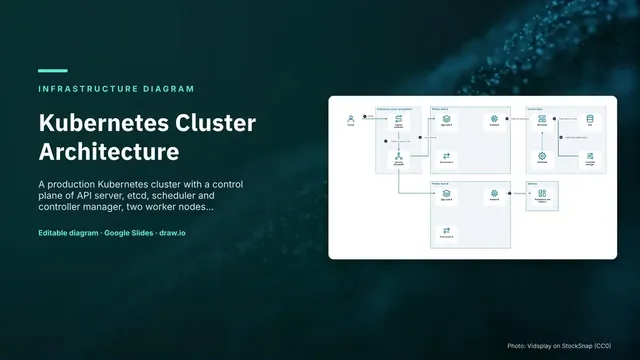
Kubernetes Cluster Architecture
Slides + PowerPoint5 slides
Free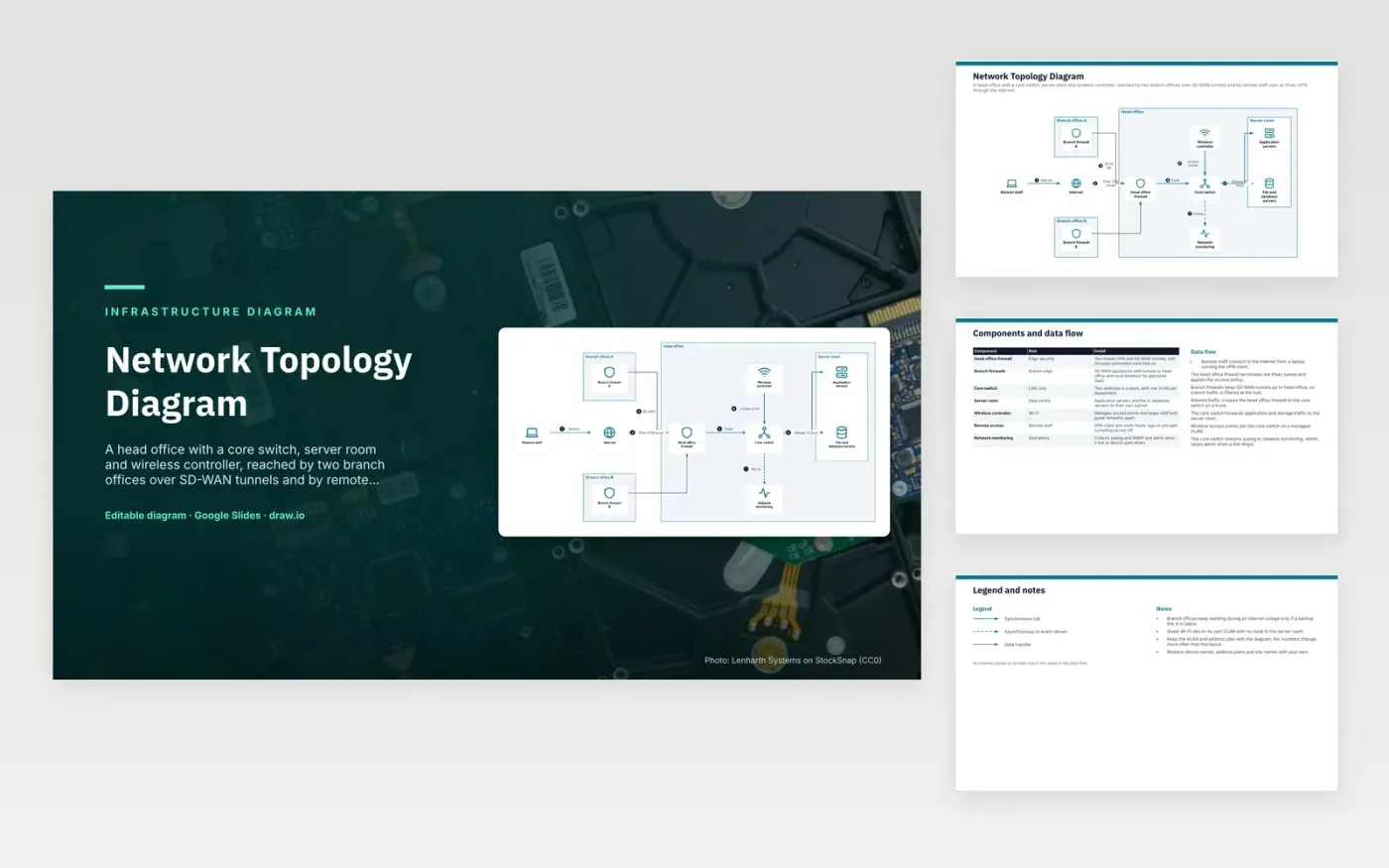
Remote staff connect to the internet from a laptop running the VPN client, and the head office firewall terminates the IPsec tunnel. Branch firewalls keep SD-WAN tunnels up to the head office, so branch traffic is filtered at the hub. Allowed traffic crosses the firewall on a trunk to the core switch, which forwards application and storage traffic to the server room. Wireless access points join the core on a managed VLAN. The core switch streams syslog to network monitoring, which raises an alert when a link drops.
The head office is the hub, so the firewall is where policy applies to remote and branch traffic alike. Branch sites keep working through an internet outage only when a backup link is in place. Guest Wi-Fi sits on its own VLAN with no route to the server room, and each department has its own VLAN on the core. A company with more sites would add branch firewalls and extend the VLAN plan, keeping the address records in step with the drawing.
Click Make a copy in Google Slides, then confirm on the Google page. The copy is saved to your own Google Drive.
Rename Remote staff, Branch firewall A, Internet and the other boxes inside Head office to your own components, and delete the ones your system does not have.
Rewrite the 7-step data flow and the 7-row components table so they match the arrows you keep.
For the draw.io version, download network-topology-diagram.drawio and open it at app.diagrams.net.
SD-WAN manages several WAN links from a central controller and chooses the best path for each application. A plain site-to-site VPN usually sends traffic over one fixed tunnel. SD-WAN can also move traffic to another link when one fails, without manual changes.
IPsec encrypts and authenticates packets between the laptop and the firewall, so traffic crossing the internet cannot be read or altered in transit. The tunnel is set up by IKE, which agrees the keys at each end. With split tunnelling turned off, all of the laptop's traffic goes through the head office.
A VLAN separates broadcast traffic and routing, so guest devices cannot reach internal servers on the same switches. Firewall rules can then allow internet access only. Guests have no path to the server room even though they share the physical network.
More Google Slides templatesMore developer workflows templates
Slides + PowerPoint5 slides
Free
Slides + PowerPoint5 slides
Free
Slides + PowerPoint5 slides
Free
Slides + PowerPoint5 slides
Free
Slides + PowerPoint5 slides
Free
Slides + PowerPoint5 slides
Free
Slides + PowerPoint5 slides
Free
Slides + PowerPoint5 slides
Free










