Network Topology Diagram
Slides + PowerPoint5 slides
Free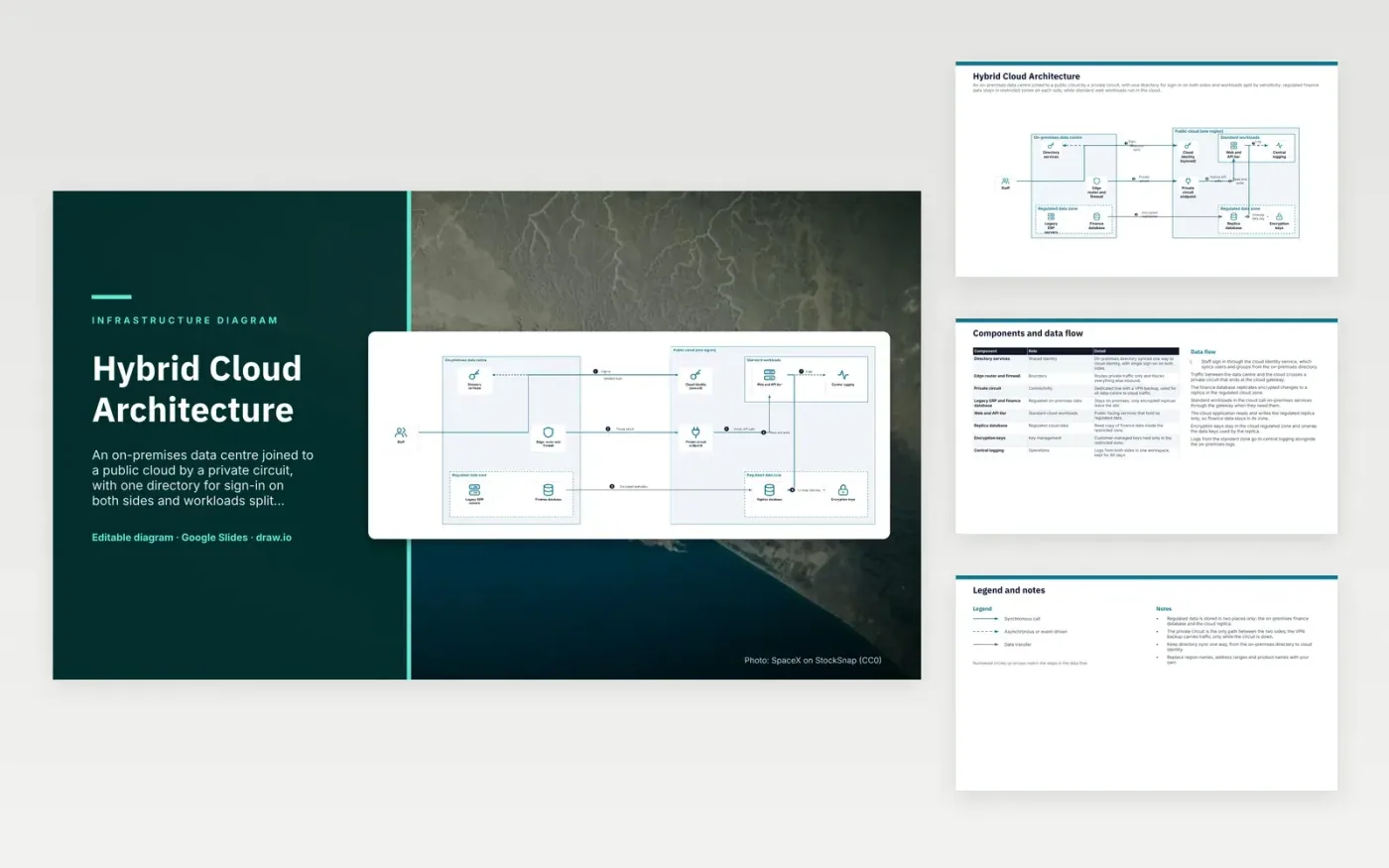
Staff sign in through cloud identity, which syncs users and groups one way from the on-premises directory. Traffic between the data centre and the cloud crosses a private circuit that ends at the cloud gateway, with a VPN as backup. The finance database replicates encrypted changes to a read replica in the restricted cloud zone. Cloud applications read and write only that replica, and encryption keys held in the restricted zone unwrap the data keys it uses. Standard workloads call on-premises services through the gateway when needed.
The design point is data residency by sensitivity. Regulated finance data is stored in only two places, the on-premises database and the cloud replica, and standard services stay out of the restricted zone. The private circuit is the normal path, and the VPN carries traffic only while the circuit is down. Directory sync runs one way, so the on-premises directory stays the source of truth. To adapt it, change the regions and address ranges, and keep the restricted and standard zones separate.
Click Make a copy in Google Slides, then confirm on the Google page. The copy is saved to your own Google Drive.
Rename Staff, Directory services, Edge router and firewall and the other boxes inside On-premises data centre to your own components, and delete the ones your system does not have.
Rewrite the 7-step data flow and the 8-row components table so they match the arrows you keep.
For the draw.io version, download hybrid-cloud-architecture-diagram.drawio and open it at app.diagrams.net.
A dedicated circuit gives a private path with steadier latency and bandwidth than a VPN over the public internet. The VPN is kept as backup, so connectivity survives a circuit failure, though at lower performance.
Syncing only from the on-premises directory to cloud identity keeps the on-premises directory as the single source of truth. Changes made in the cloud cannot write back and alter accounts on premises.
Customer-managed keys let your team control the key lifecycle, including rotation and revocation. Holding them in the restricted zone means the replica's data keys cannot be unwrapped outside that zone.
More Google Slides templatesMore developer workflows templates
Slides + PowerPoint5 slides
Free
Slides + PowerPoint5 slides
Free
Slides + PowerPoint5 slides
Free
Slides + PowerPoint5 slides
Free
Slides + PowerPoint5 slides
Free
Slides + PowerPoint5 slides
Free
Slides + PowerPoint5 slides
Free
Slides + PowerPoint5 slides
Free










