Azure Hub-Spoke Network Architecture
Slides + PowerPoint5 slides
Free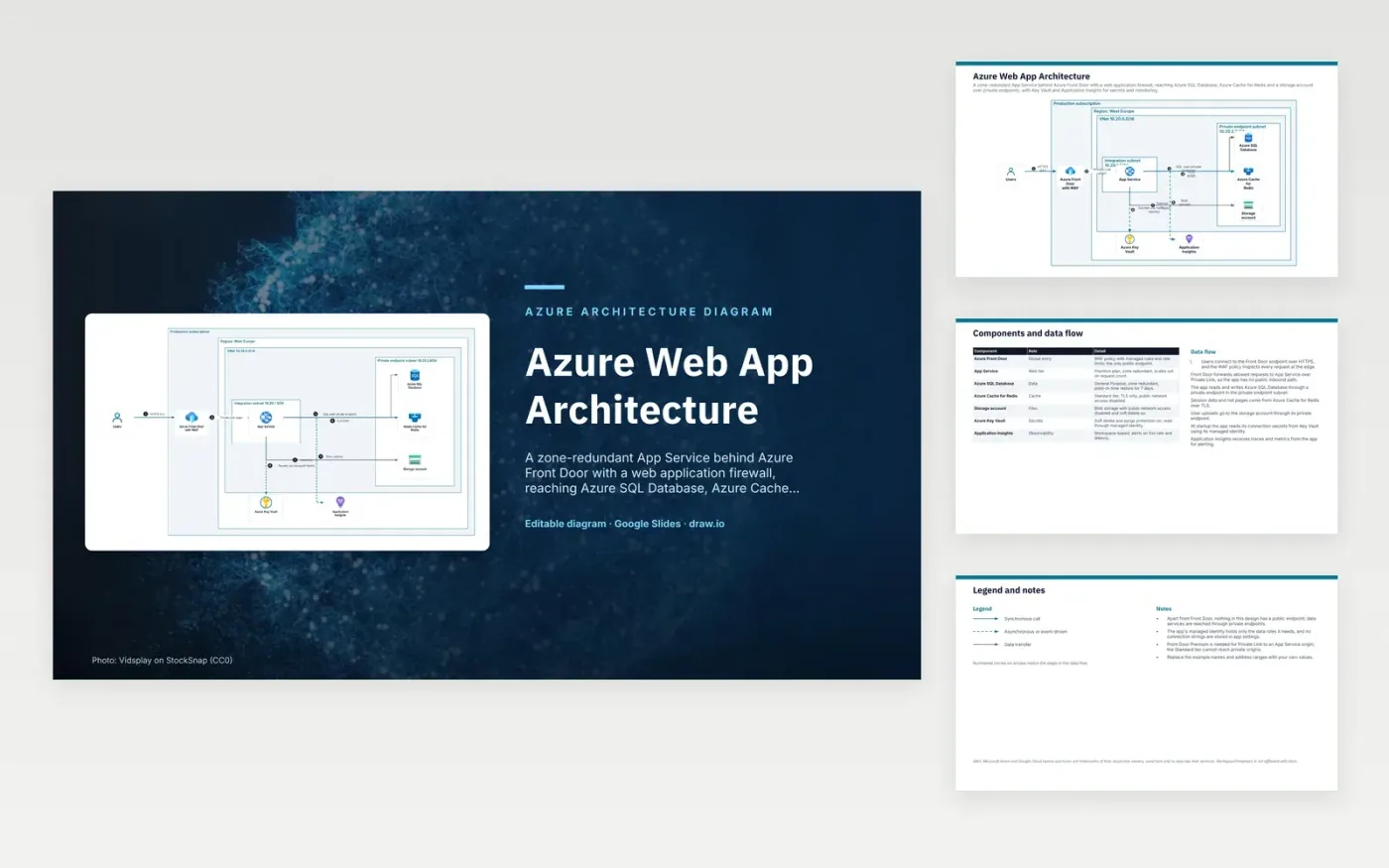
Users connect to the Azure Front Door endpoint over HTTPS, and its WAF policy inspects each request at the edge. Front Door forwards allowed requests to App Service over Private Link, so the app has no public inbound path. The app reads and writes Azure SQL Database through a private endpoint, uses Azure Cache for Redis for sessions and hot pages over TLS, and sends uploads to a storage account through its own private endpoint.
At start-up the app reads its connection secrets from Key Vault using a managed identity, so no connection strings sit in app settings. Redis and the storage account have public access turned off, and Application Insights alerts on the 5xx rate and on latency. The cost trade-off is that Private Link to an App Service origin needs Front Door Premium. Teams reusing this should replace the example names and address ranges, and give the identity only the data roles it needs.
The diagram uses the official Microsoft Azure architecture icons, each labelled with its service name. AWS, Microsoft Azure and Google Cloud names and icons are trademarks of their respective owners, used here only to describe their services. WorkspaceTemplates is not affiliated with them.
Click Make a copy in Google Slides, then confirm on the Google page. The copy is saved to your own Google Drive.
Rename Users, Azure Front Door with WAF, App Service and the other boxes inside Production subscription to your own components, and delete the ones your system does not have.
Rewrite the 7-step data flow and the 7-row components table so they match the arrows you keep.
For the draw.io version, download azure-web-app-architecture-diagram.drawio and open it at app.diagrams.net.
Private Link to an App Service origin is available only on Front Door Premium, and the Standard tier cannot reach private origins. Premium lets the app keep no public inbound endpoint while Front Door stays the only public entry point.
A managed identity lets the app request access tokens from Azure, so no password or key is stored in its settings. Each identity needs only the data roles it uses, which limits what a leaked setting could reach.
It gives the database a private IP address in a chosen subnet, so the app reaches it over the virtual network rather than the public internet. Clients outside the network cannot connect to that address.
More Google Slides templatesMore developer workflows templates
Slides + PowerPoint5 slides
Free
Slides + PowerPoint5 slides
Free
Slides + PowerPoint5 slides
Free
Slides + PowerPoint5 slides
Free
Slides + PowerPoint5 slides
Free
Slides + PowerPoint5 slides
Free
Slides + PowerPoint5 slides
Free
Slides + PowerPoint5 slides
Free










