Azure Hub-Spoke Network Architecture
Slides + PowerPoint5 slides
Free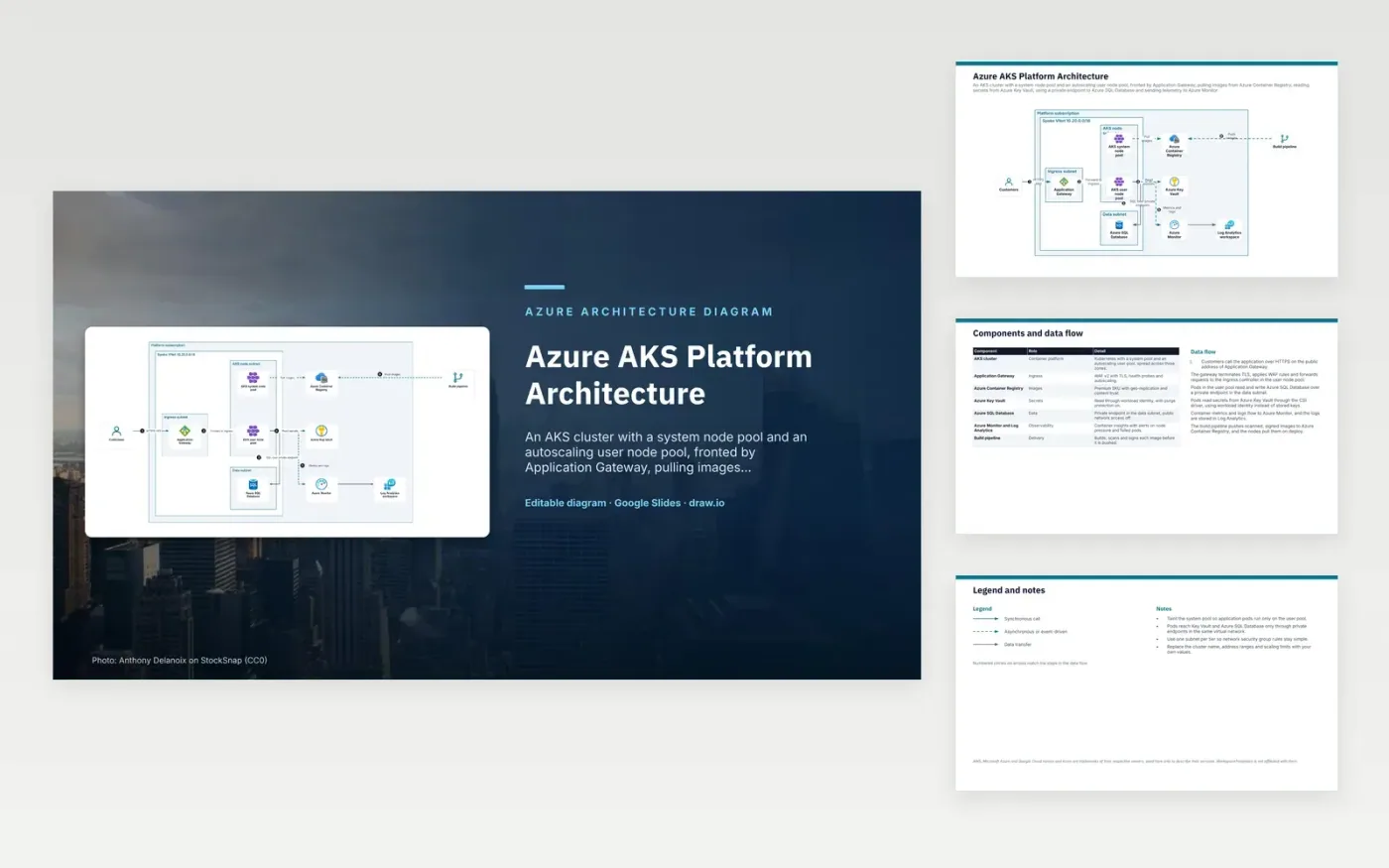
Customers call the application over HTTPS on the public address of Application Gateway, which terminates TLS, applies WAF rules and forwards requests to the ingress controller in the AKS user node pool. Pods there read and write Azure SQL Database over a private endpoint, and read secrets from Azure Key Vault through the CSI driver. Their metrics and logs go to Azure Monitor. The build pipeline pushes signed images to Azure Container Registry, and nodes pull them when a deployment runs.
The system pool is tainted so application pods run only on the user pool, which keeps cluster add-ons apart from customer workloads. Workload identity replaces stored keys for Key Vault, and each data service is reached through a private endpoint. To adapt it, keep the taint and the private endpoints, then size the autoscaling range and gateway capacity to your own traffic.
The diagram uses the official Microsoft Azure architecture icons, each labelled with its service name. AWS, Microsoft Azure and Google Cloud names and icons are trademarks of their respective owners, used here only to describe their services. WorkspaceTemplates is not affiliated with them.
Click Make a copy in Google Slides, then confirm on the Google page. The copy is saved to your own Google Drive.
Rename Customers, Application Gateway, AKS system node pool and the other boxes inside Platform subscription to your own components, and delete the ones your system does not have.
Rewrite the 6-step data flow and the 7-row components table so they match the arrows you keep.
For the draw.io version, download azure-aks-platform-architecture-diagram.drawio and open it at app.diagrams.net.
The system pool runs cluster add-ons such as core DNS and metrics components. Tainting it stops application pods from landing there, so a busy app cannot starve the add-ons. The user pool scales for workloads while the system pool stays small and fixed.
Application Gateway terminates TLS and runs web application firewall rules on each request before it reaches the cluster. Its health probes and autoscaling then steer traffic to healthy ingress pods. The WAF blocks many common web attacks, but it does not replace secure code.
With workload identity, a pod's Kubernetes service account is linked to a Microsoft Entra identity, and the pod gets a token for that identity. The Key Vault CSI driver then reads the secret and mounts it. No client secret is kept in the cluster.
More Google Slides templatesMore developer workflows templates
Slides + PowerPoint5 slides
Free
Slides + PowerPoint5 slides
Free
Slides + PowerPoint5 slides
Free
Slides + PowerPoint5 slides
Free
Slides + PowerPoint5 slides
Free
Slides + PowerPoint5 slides
Free
Slides + PowerPoint5 slides
Free
Slides + PowerPoint5 slides
Free










