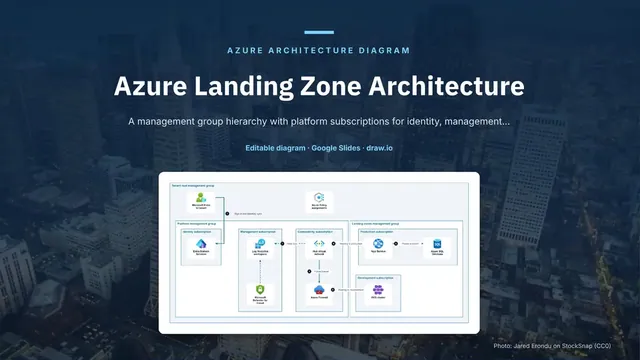
Azure Landing Zone Architecture
Slides + PowerPoint5 slides
Free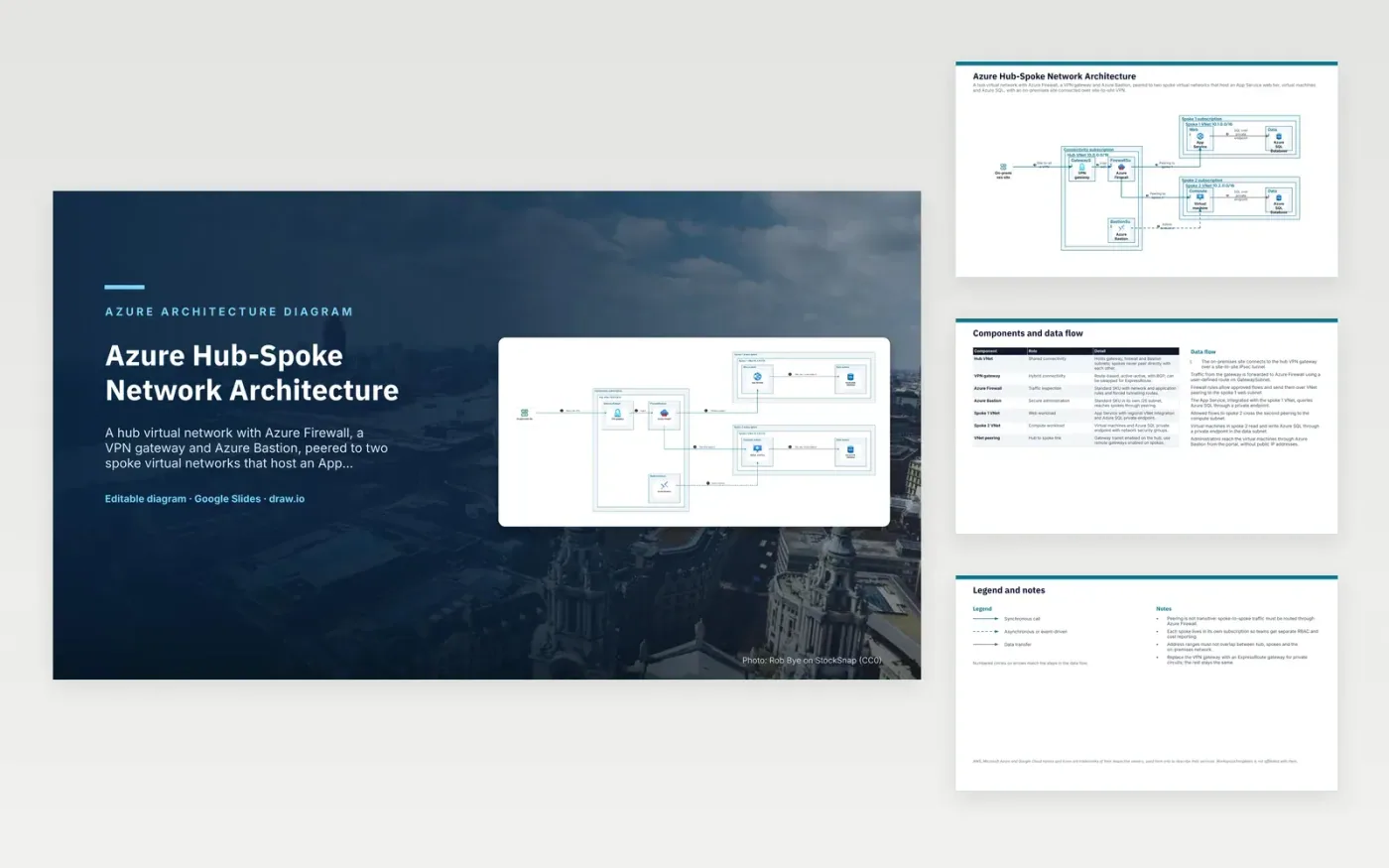
A request from the on-premises head office enters the hub through a site-to-site VPN gateway. A user-defined route on the gateway subnet sends that traffic to Azure Firewall, which inspects it and applies the allow rules. Approved flows cross VNet peering into spoke 1, where App Service reaches Azure SQL over a private endpoint. Other approved flows cross a second peering into spoke 2, where virtual machines use their own private endpoint. Administrators reach those machines through Bastion without public IP addresses.
The hub holds the shared services, and the spokes never peer with each other, because peering is not transitive. Spoke-to-spoke traffic therefore has to pass through Azure Firewall, which also gives one place for policy. Each spoke sits in its own subscription, so each team gets separate access control and cost reporting. Address ranges must not overlap, and the VPN gateway can be swapped for ExpressRoute when a private circuit is needed.
The diagram uses the official Microsoft Azure architecture icons, each labelled with its service name. AWS, Microsoft Azure and Google Cloud names and icons are trademarks of their respective owners, used here only to describe their services. WorkspaceTemplates is not affiliated with them.
Click Make a copy in Google Slides, then confirm on the Google page. The copy is saved to your own Google Drive.
Rename On-premises site, VPN gateway, Azure Firewall and the other boxes inside Connectivity subscription to your own components, and delete the ones your system does not have.
Rewrite the 7-step data flow and the 7-row components table so they match the arrows you keep.
For the draw.io version, download azure-hub-spoke-network-architecture-diagram.drawio and open it at app.diagrams.net.
VNet peering is not transitive, so a spoke cannot reach another spoke just because both peer with the hub. Routing spoke-to-spoke traffic through Azure Firewall with user-defined routes lets the firewall inspect and allow or deny each flow.
A VPN gateway carries encrypted IPsec traffic between the head office and the hub over the internet. ExpressRoute uses a private circuit from a connectivity provider and does not travel over the public internet.
A private endpoint gives the database a private IP address inside the spoke's virtual network. SQL traffic then stays on private addresses instead of crossing the public internet.
More Google Slides templatesMore developer workflows templates
Slides + PowerPoint5 slides
Free
Slides + PowerPoint5 slides
Free
Slides + PowerPoint5 slides
Free
Slides + PowerPoint5 slides
Free
Slides + PowerPoint5 slides
Free
Slides + PowerPoint5 slides
Free
Slides + PowerPoint5 slides
Free
Slides + PowerPoint5 slides
Free










