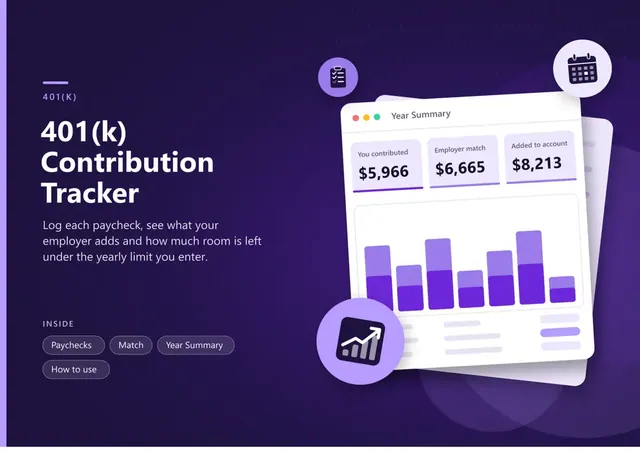
401(k) Contribution Tracker
Sheets + Excel6 tabs
Free14 templates
Sheets + Excel6 tabs
Free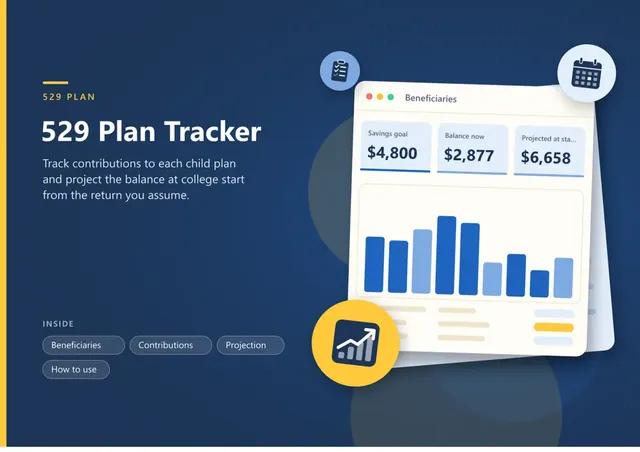
Sheets + Excel6 tabs
Free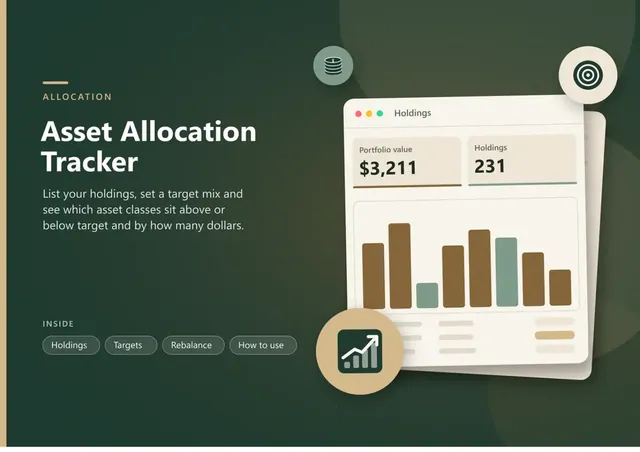
Sheets + Excel5 tabs
Free
Sheets + Excel6 tabs
Free
Sheets + Excel6 tabs
Free
Sheets + Excel7 tabs
Free
Sheets + Excel5 tabs
Free
Sheets + Excel5 tabs
Free
Sheets + Excel5 tabs
Free
Sheets + Excel5 tabs
Free
Sheets + Excel6 tabs
Free
Sheets + Excel7 tabs
Free
Sheets + Excel5 tabs
Free
Sheets + Excel5 tabs
Free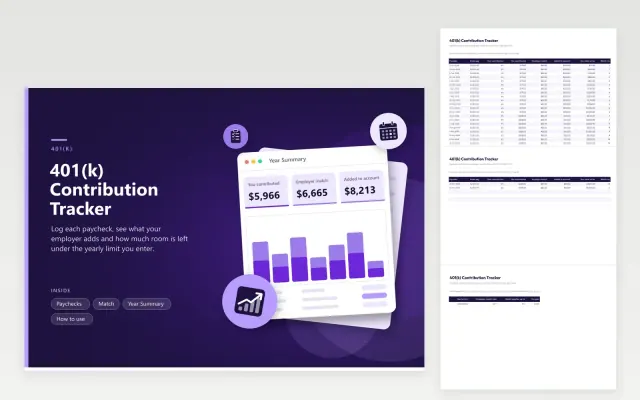 401(k) Contribution Tracker | 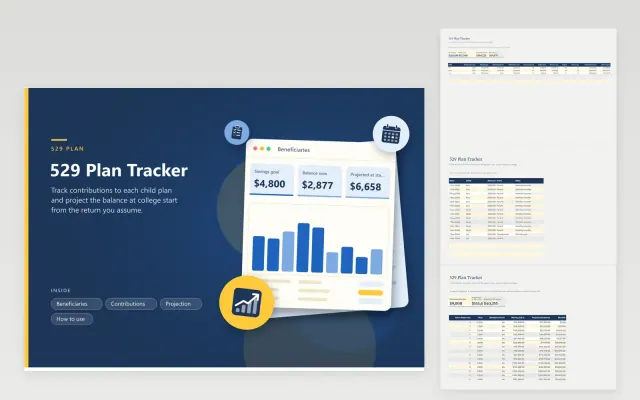 529 Plan Tracker | 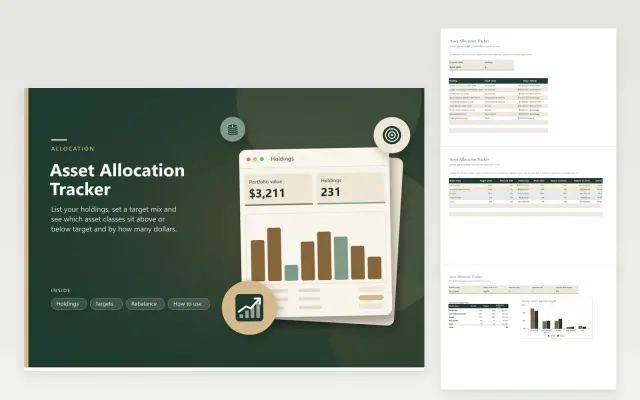 Asset Allocation Tracker | 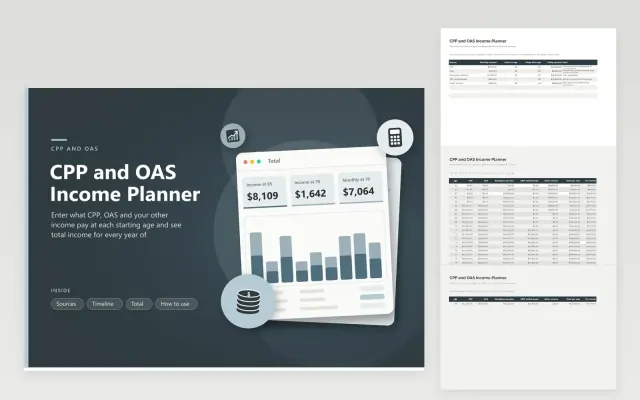 CPP and OAS Income Planner | |
|---|---|---|---|---|
| Format | Spreadsheet | Spreadsheet | Spreadsheet | Spreadsheet |
| Works in | Google Sheets and Excel | Google Sheets and Excel | Google Sheets and Excel | Google Sheets and Excel |
| Length | 6 slides | 6 slides | 5 slides | 6 slides |
| Style | Modern | Friendly | Editorial | Minimal |
An investment tracker is a record of your own accounts and contributions, kept by you in a sheet. These templates cover retirement accounts, 401k and IRA contribution logs, education savings plans in the US and Canada, dollar-cost averaging, a trade journal, a watchlist, asset allocation and rebalancing, fee comparisons and income planners. They do arithmetic on numbers you enter and give no investment advice.
Cover account name and type, date and amount of each contribution, balance by date, target allocation against actual, fees paid, and a cell for each annual limit, with a note to check the official figure.
Contribution limits change and are published by the IRS and CRA, so type the current figure into the limit cell yourself. Update balances on December 31, 2026, and again when year-end statements arrive.
Compare 401(k) Contribution Tracker, 529 Plan Tracker, and Asset Allocation Tracker, all 5 to 7 pages long, then pick the closest match and replace the sample text with your own.
An investment tracker is a record of your own accounts and contributions, kept by you in a sheet. These templates cover retirement accounts, 401k and IRA contribution logs, education savings plans in the US and Canada, dollar-cost averaging, a trade journal, a watchlist, asset allocation and rebalancing, fee comparisons and income planners. They do arithmetic on numbers you enter and give no investment advice.
Include account name and type, date and amount of each contribution, balance by date, target allocation against actual, fees paid, and a cell for each annual limit, with a note to check the official figure. Contribution limits change and are published by the IRS and CRA, so type the current figure into the limit cell yourself. Update balances on December 31, 2026, and again when year-end statements arrive.
List each holding with the date bought, the amount invested and the current value. A summary tab can then total balances by account and compare the real mix with your target.
It means investing a fixed amount at regular intervals, whatever the price. The average cost per share is total dollars invested divided by total shares, which the tracker calculates for you.
No. They track and calculate from what you enter. For advice on what to buy, sell or hold, speak with a licensed financial professional.
Start with 401(k) Contribution Tracker: Each paycheck with your contribution, the employer match it earns and how far you are through the yearly limit you enter. If that is not the right fit, compare it with 529 Plan Tracker.
The templates here are 5 to 7 pages long. Cut any section you do not need; each template explains what its sections are for.
Yes. These investment tracker templates work in Google Sheets and Microsoft Excel. All 14 templates are free, with no account or email needed.