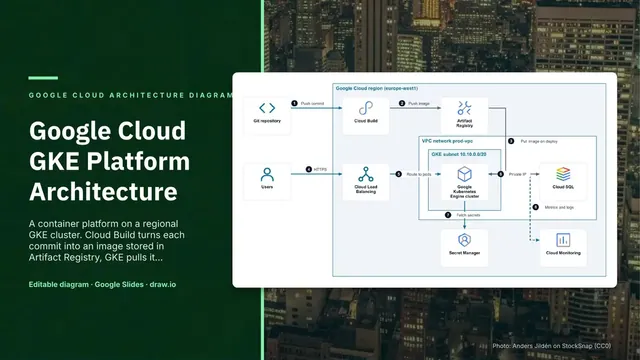
Google Cloud GKE Platform Architecture
Slides + PowerPoint5 slides
Free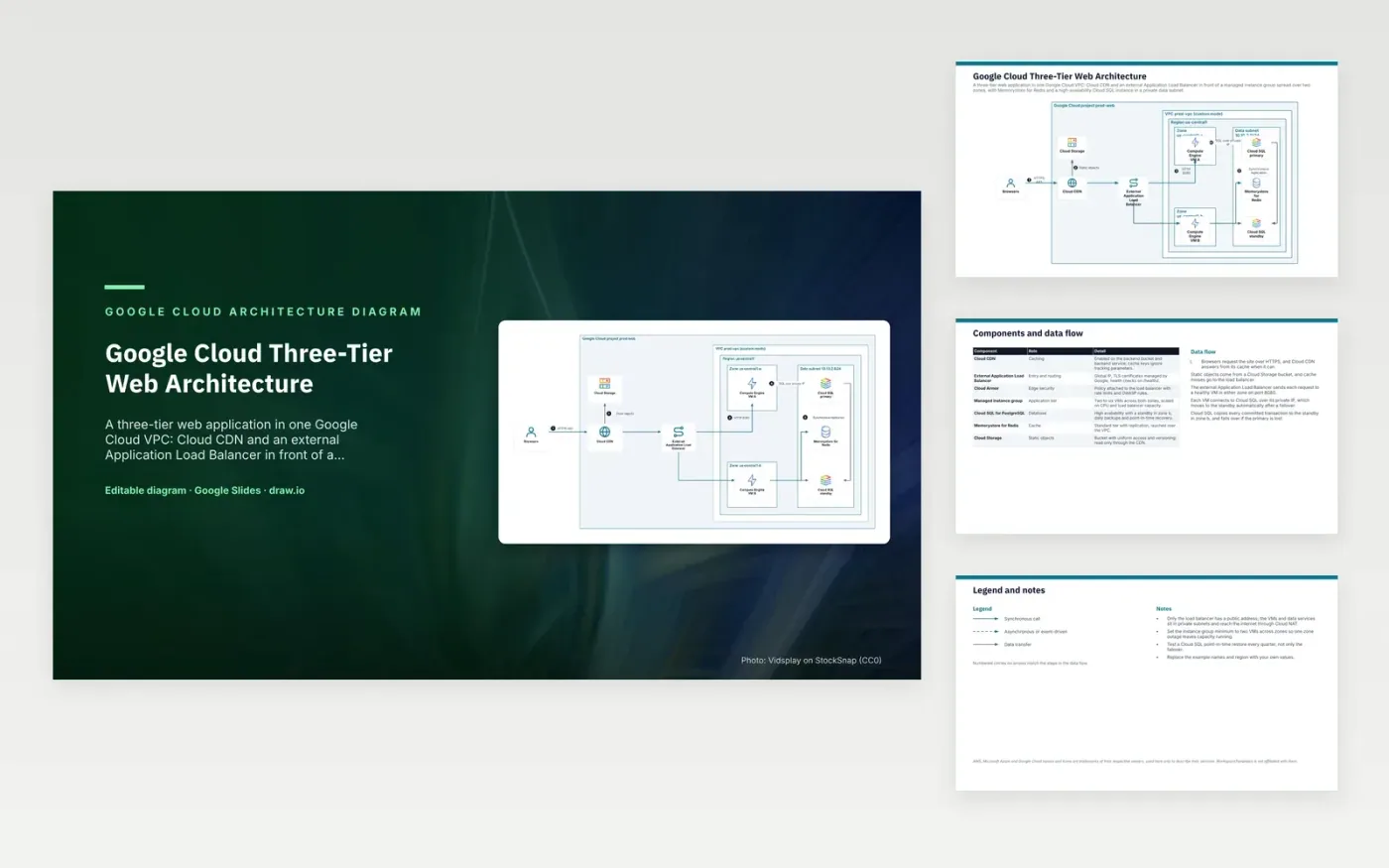
A browser requests the site over HTTPS, and Cloud CDN answers from its cache when it can. Static objects come from a Cloud Storage bucket, and cache misses reach the external Application Load Balancer, which hands each request to a healthy VM in either zone on port 8080. Each VM connects to Cloud SQL over its private IP address. Cloud SQL copies each committed transaction to a standby in zone b, which takes over after a failure.
Public exposure is kept to one point. Only the load balancer has a public address, while VMs and data services stay in private subnets and reach the internet through Cloud NAT. Cloud Armor rate limits and OWASP rules sit on the load balancer, so abusive traffic is stopped at the edge. A minimum of two VMs across both zones keeps capacity running if one zone fails. To adapt it, test a point-in-time restore each quarter as well as the failover.
The diagram uses the official Google Cloud architecture icons, each labelled with its service name. AWS, Microsoft Azure and Google Cloud names and icons are trademarks of their respective owners, used here only to describe their services. WorkspaceTemplates is not affiliated with them.
Click Make a copy in Google Slides, then confirm on the Google page. The copy is saved to your own Google Drive.
Rename Browsers, Cloud Storage, Cloud CDN and the other boxes inside Google Cloud project prod-web to your own components, and delete the ones your system does not have.
Rewrite the 5-step data flow and the 7-row components table so they match the arrows you keep.
For the draw.io version, download gcp-three-tier-web-architecture-diagram.drawio and open it at app.diagrams.net.
Cloud CDN caches responses on the backend bucket and backend service when they are cacheable. Cache keys ignore tracking parameters, so the same page is not stored many times under different URLs.
A standby in another zone keeps the database available if its zone fails. Each commit is copied to it synchronously before it is confirmed, so a failover loses no confirmed change.
Cloud Armor applies security policies at the edge of the load balancer. Rate limits and OWASP rule sets block abusive or malicious requests before they reach the VMs.
More Google Slides templatesMore developer workflows templates
Slides + PowerPoint5 slides
Free
Slides + PowerPoint5 slides
Free
Slides + PowerPoint5 slides
Free










