API Documentation
Docs + Word14 pages
Free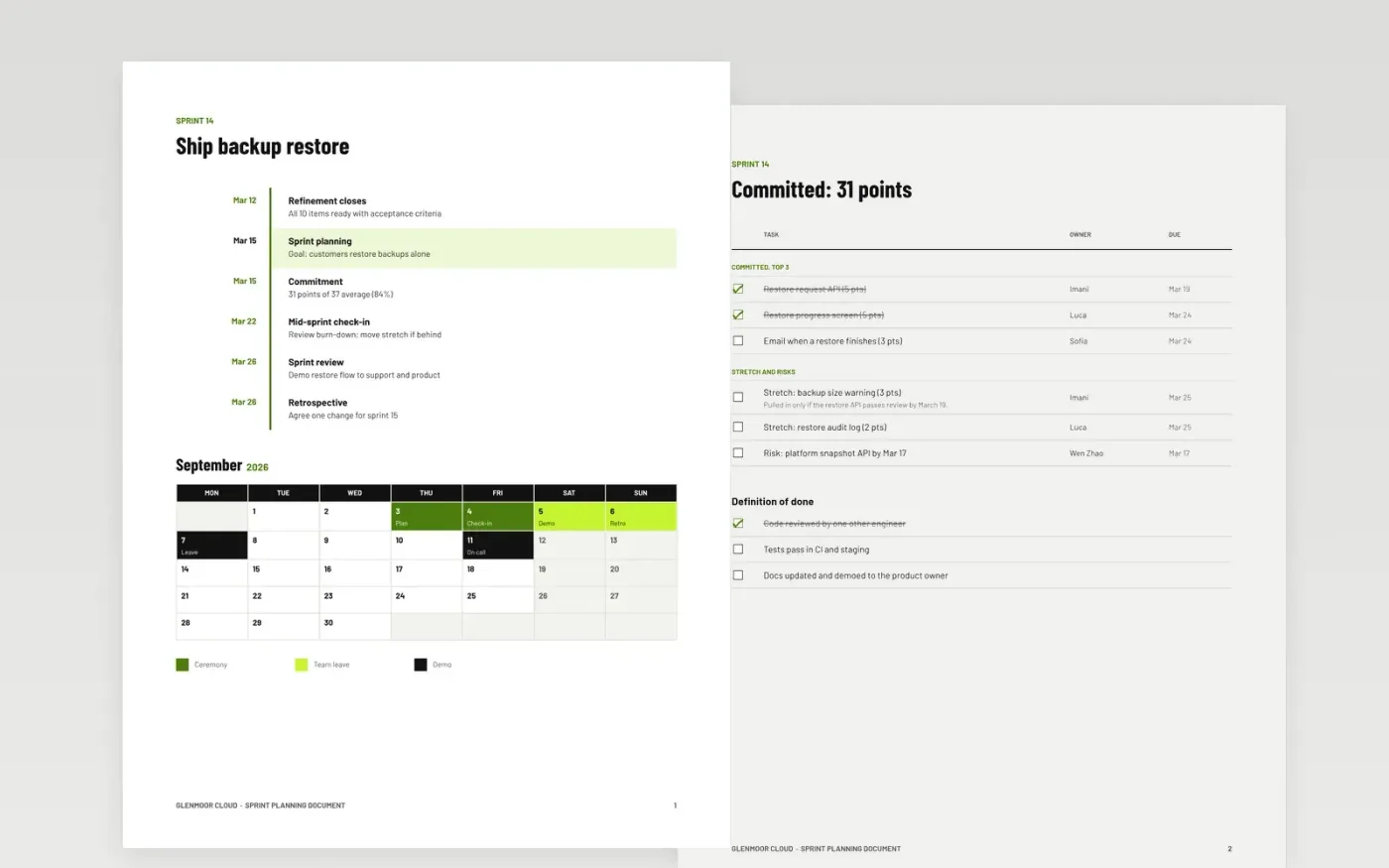
Sprints go wrong when the goal is a list of tickets and the commitment ignores leave, on-call load and the team's real average velocity. This template keeps planning to a few pages: the sprint goal with key dates and a calendar, a checklist of committed and stretch items with owners and due dates, risks and dependencies, and the definition of done.
The sample follows a seven-person Glenmoor Cloud team in sprint 14: 55 available days at a 0.65 focus factor gives 36 points, a 3-sprint average of 37, and a commitment of 31 points (84%) with 5 points of stretch. Replace the dates and goal, enter each person's available days and move anything above 90% of average velocity to stretch.
Click Make a copy in Google Docs, then confirm on the Google page. The copy is saved to your own Google Drive.
Set the sprint dates and replace the goal with a single outcome sentence, not a list of tickets.
Enter each person's available days, apply your focus factor and commit no more than 90% of your 3-sprint average velocity.
Replace the items with your refined backlog, each with an estimate and owner, and name the owner and delivery date of each dependency.
Delete the guide page at the end, then share the document with the team.
Aim for 80 to 90% of your 3-sprint average velocity, then add one or two stretch items. Committing to your best-ever sprint almost guarantees carry-over.
No. The sample uses two weeks, but you can change the dates and recalculate capacity for one-week or three-week sprints. The checklist and timeline work the same way.
No. Glenmoor Cloud, its people, email addresses and every figure are fictional sample data. Replace them with your own team, dates and estimates before sharing.
More Google Docs templatesMore developer workflows templates
Docs + Word14 pages
Free
Slides + PowerPoint12 slides
Free
Docs + Word16 pages
Free
Docs + Word7 pages
Free
Docs + Word6 pages
Free