API Documentation
Docs + Word14 pages
Free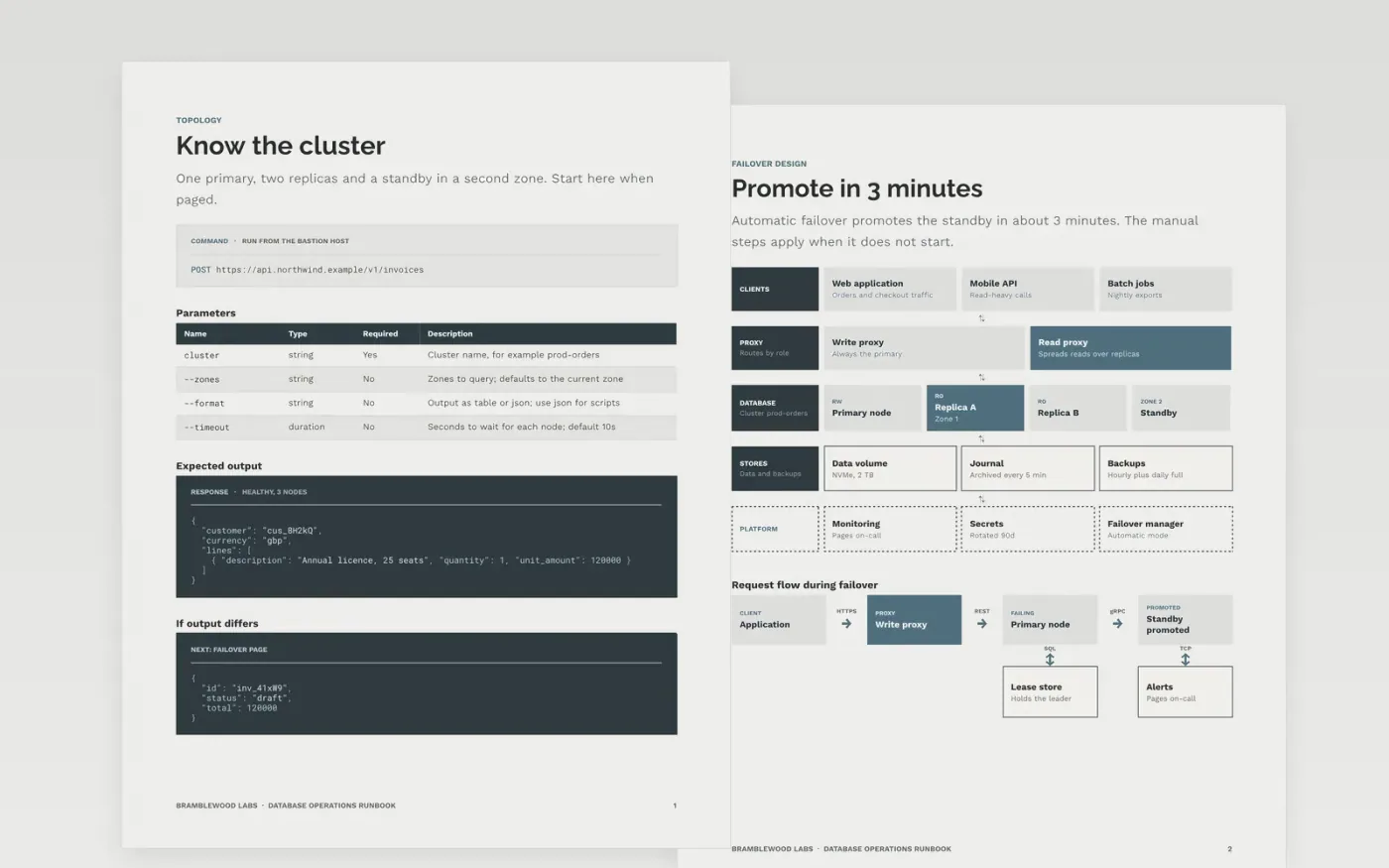
A database runbook fails when it assumes context: which cluster, which zone, what the output should look like. This template gives every procedure the same shape, with the exact command, a parameters table, the expected output and a stop condition. It covers topology, failover, restore, scaling and routine maintenance on separate pages.
The sample follows a fictional cluster, prod-orders, at Bramblewood Labs, with a 45 minute recovery time, a 5 minute recovery point and a 99.9% availability target. Replace the cluster details, run each command in staging, paste the real output, and update the contacts and review date before you share it with the rota.
Click Make a copy in Google Docs, then confirm on the Google page. The copy is saved to your own Google Drive.
Replace the cluster name, zones, owner team and on-call channel with your own on the topology and failover pages.
Run each command in staging, paste the real output and keep the check that confirms success.
Update recovery targets, thresholds, contacts and the next review date.
Delete the guide page, then share the runbook with your rota and link it from every alert.
Yes. Make a copy in Google Docs at no cost and edit every command, table and diagram label in your own Drive.
No. Bramblewood Labs, its cluster, its people and every figure are fictional sample content. Replace them with your own details before sharing.
No. The commands use a generic dbctl tool so the structure stays neutral. Swap in your own commands, flags and expected output for whichever engine you run.
More Google Docs templatesMore developer workflows templates
Docs + Word14 pages
Free
Slides + PowerPoint12 slides
Free
Docs + Word17 pages
Free
Docs + Word6 pages
Free
Docs + Word7 pages
Free
Docs + Word8 pages
Free
Docs + Word8 pages
Free