Quarterly Board Report
Docs + Word17 pages
Free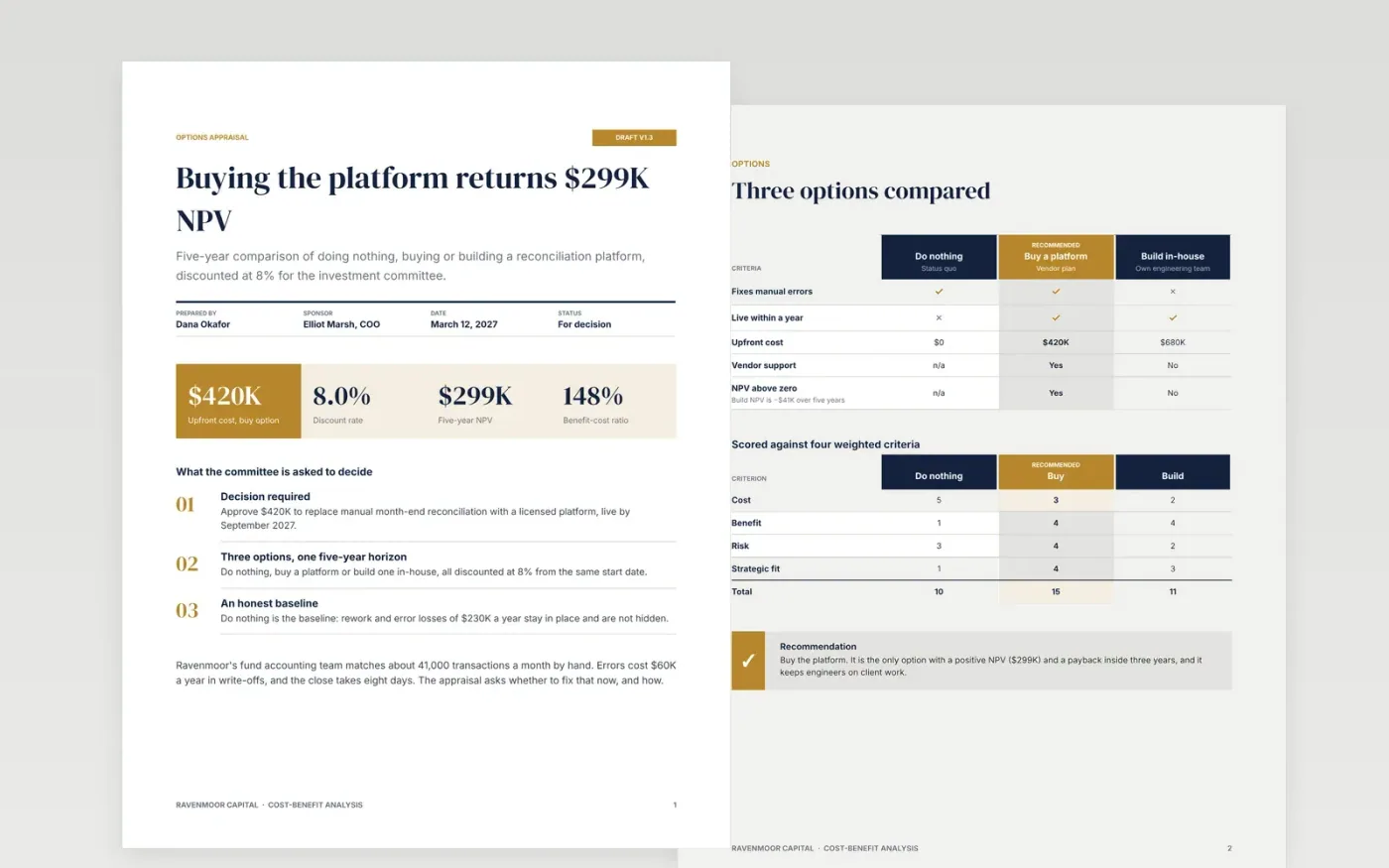
Managers are often asked to choose between doing nothing, buying and building, and the case rests on assumptions nobody can see. This document lays the decision out in order: purpose, options compared, costs by year, benefits with evidence, NPV and payback, then a recommendation with a sign-off box.
The sample follows Ravenmoor Capital choosing how to replace manual reconciliation. Buying returns a $299K NPV at 8% over five years with a 2.3-year payback, and the sensitivity page shows where the choice flips. Replace the decision, options, yearly costs, benefits and discount rate with your own.
Click Make a copy in Google Docs, then confirm on the Google page. The copy is saved to your own Google Drive.
State the decision, the options and the horizon in the first box, then enter costs by year for each option, including the do-nothing baseline.
Enter benefits with the evidence for each, discount costs and benefits at your finance policy's rate, and update the charts and the key figures table.
Run the sensitivity at benefits minus 20% and costs plus 20%, note where the choice flips, and write your recommendation and next steps.
Delete the guide page, then share the document with your approver or present it at the committee.
Use the rate set by your finance policy or treasury, usually 7 to 10 percent. The sample uses 8 percent for every option so the comparison stays fair.
Doing nothing is the honest baseline. Without it every option looks positive, because benefits that need no investment get credited to the project.
No. Ravenmoor Capital, the people, the email addresses and every figure in the sample are fictional. Replace them with your own details before sharing.
Docs + Word17 pages
Free
Docs + Word6 pages
Free
Excel
Free
Docs + Word8 pages
Free
Slides + PowerPoint10 slides
Free