Simple CV
Docs + Word1 page
Free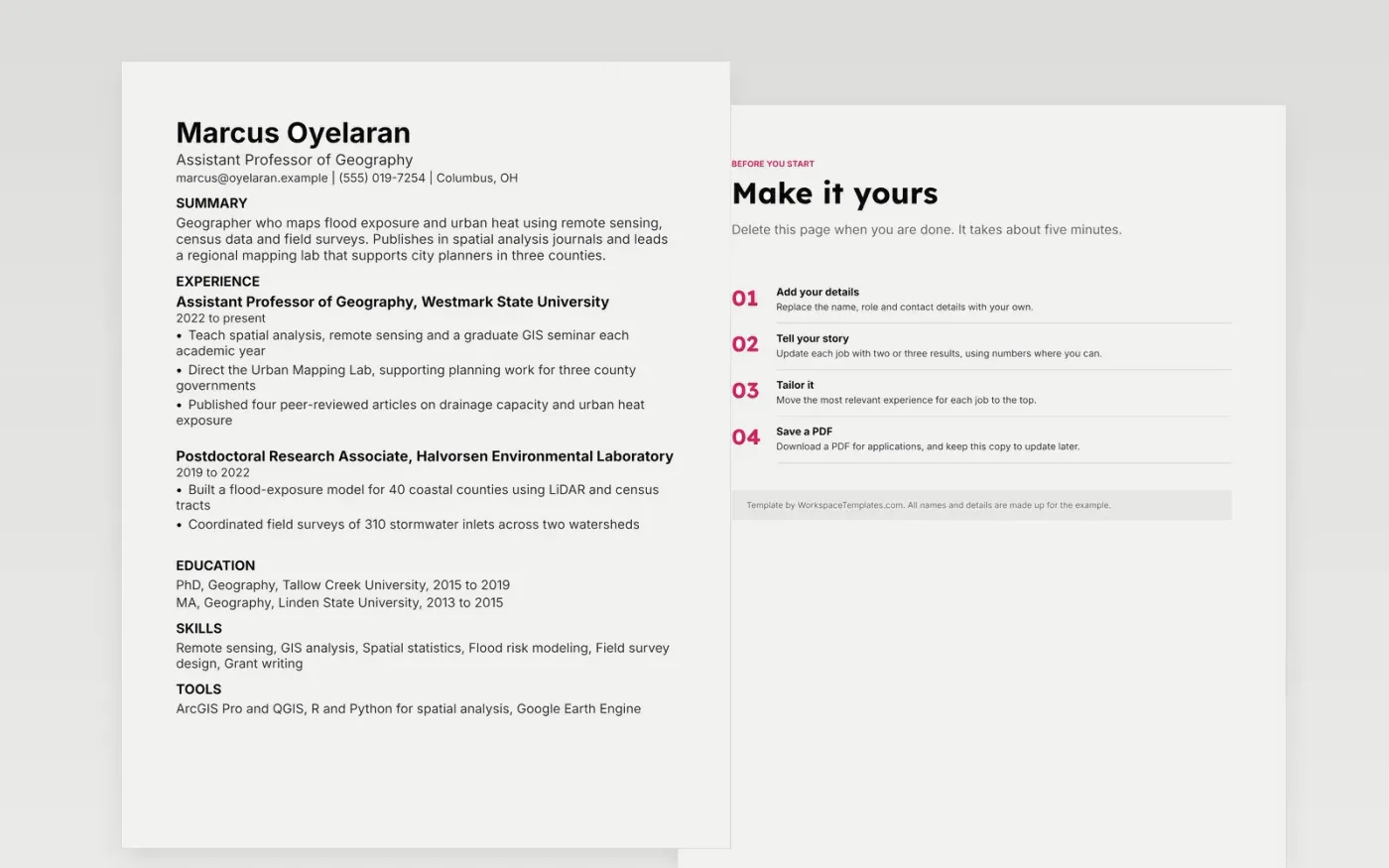
Geography hiring committees, whether for a faculty post or a research scientist role, look for a clear method, data they can check and papers that report it. They want GIS and remote sensing skills backed by real projects, plus evidence the work reached planners, agencies or community groups. Tracking software reads many university and government forms before a person does, which rewards plain headings, standard dates and no text boxes. This layout uses only those elements, with publications and grants in a simple order that parsers handle reliably.
The sample geographer is an assistant professor who models flood exposure and urban heat, runs a mapping lab and has published four articles on drainage. Swap in your own posts, grants and tools, and keep each project line to one measurable outcome, such as the number of counties, sites or survey points covered. Practical tip: if you have a data set or map product people can download, name it with its link, since committees value shared work. Avoid tables, which some parsers flatten into a jumble.
Make a copy in Google Docs, or download the Word file.
Type over the sample text with your own details.
Delete the guide page when you are done.
Print it, or save it as a PDF.
Many universities and agencies run applications through tracking software that reads text in order. Columns, icons and text boxes can scramble that order and drop dates or titles. Standard headings keep every publication and grant in the spot the parser expects. The format does not weaken your case, since committees judge content, and clear structure helps them find it.
Name the software you used in real projects, such as ArcGIS Pro, QGIS, R or Python, and the analysis methods, such as spatial statistics or remote sensing classification. Describe the data types you worked with, including LiDAR, satellite imagery and census tracts. Avoid listing tools you have only seen in a course. A short list tied to specific projects reads as more credible than a long one.
Academic geography CVs usually run several pages, since publications, grants and teaching all need space. Government and consultancy applications often ask for two to three pages. Put the strongest recent work at the top and move older projects into a short list. Check the job advert, because some agencies set a page limit and ignore anything beyond it.
Docs + Word1 page
Free
Docs + Word1 page
Free
Docs + Word1 page
Free
Docs + Word1 page
Free
Docs + Word1 page
Free
Docs + Word1 page
Free
Docs + Word1 page
Free
Docs + Word1 page
Free
Docs + Word1 page
Free
Docs + Word1 page
Free
Docs + Word1 page
Free
Docs + Word1 page
Free
Docs + Word1 page
Free
Docs + Word1 page
Free
Docs + Word1 page
Free