Simple CV
Docs + Word1 page
Free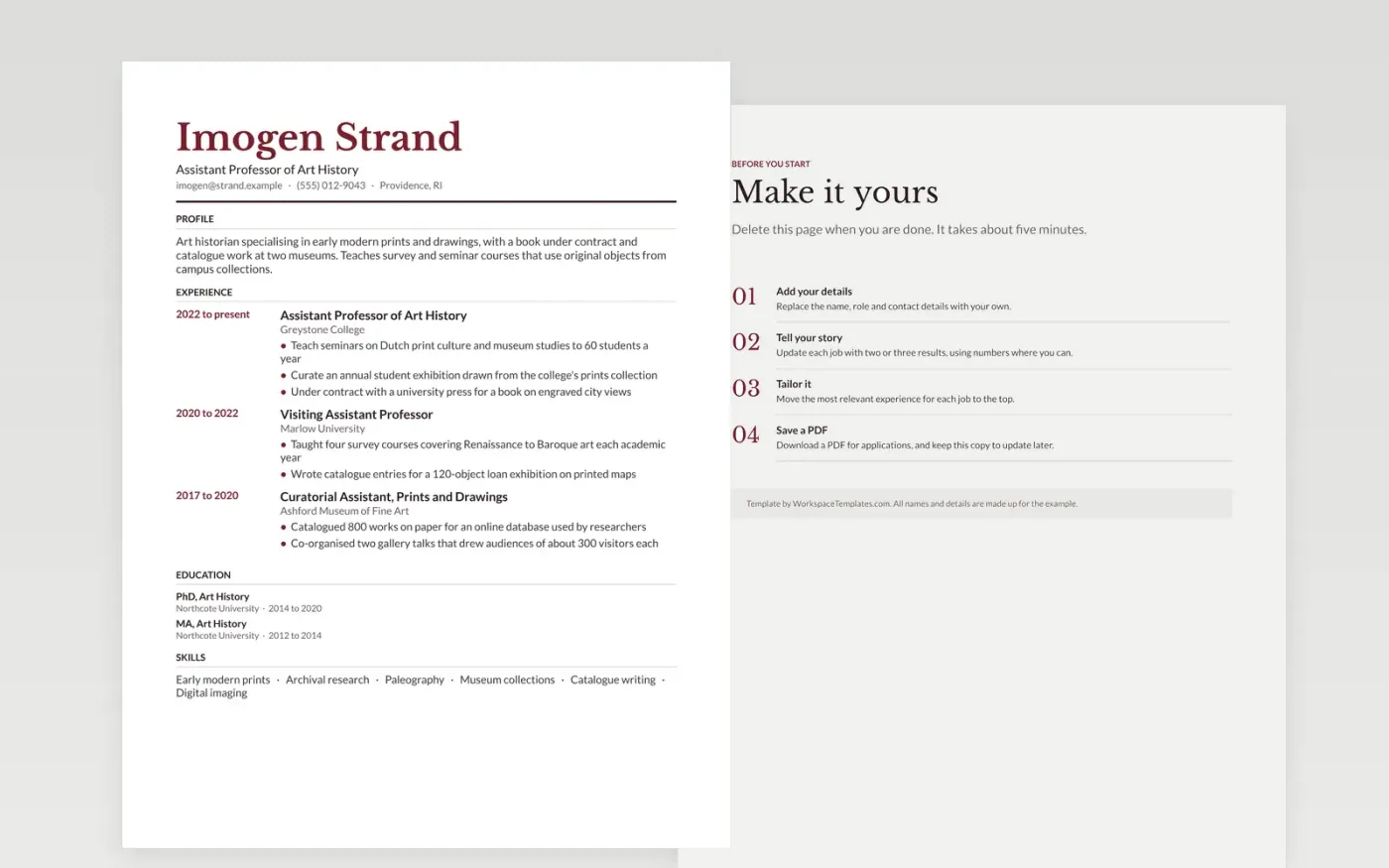
Hiring committees for art history posts want to see scholarship in two forms: a book or articles that make an argument about objects, and the archival or museum work behind them. They look for teaching across survey and seminar courses, experience with original collections and grants that fund research trips. Committees also weigh public engagement, such as exhibitions and gallery talks. A dated layout helps here because every post shows its years beside it, so a panel can see how museum work, teaching and publishing developed in parallel.
The sample art historian is an assistant professor who studies early modern prints, with a book under contract and catalogue experience at a museum. Replace the institutions, awards and exhibitions with your own, and be exact about the dates. Practical tip: for each museum role, give one object-based result, such as a catalogue entry, a database of works or an exhibition checklist, since panels value concrete outputs. List the book with its press and status, even if it is still in production.
Make a copy in Google Docs, or download the Word file.
Type over the sample text with your own details.
Delete the guide page when you are done.
Print it, or save it as a PDF.
Give the author list, the title, the press and the status, such as under contract or in production with an expected date. Do not list it as published until it is in print. If the press is well known in the field, name it in full; otherwise add a short note on the series. Mention the book in the summary only if it is central to your application.
Teaching posts rarely require it, though it helps an application to a college with a collection or a research museum. Describe museum work by task and result, such as catalogued objects, organised exhibitions or led talks. Even a short internship can count if it shows object-based research. Put the most relevant museum post near the top of the timeline.
Include fellowships, prizes, research grants and travel awards with the year and the funder. Put the most selective awards first. A prize for an article or book is worth listing with the society that gave it. Awards from your own institution belong in a separate line, so panels can tell them apart from competitive national funding.
Docs + Word1 page
Free
Docs + Word1 page
Free
Docs + Word1 page
Free
Docs + Word1 page
Free
Docs + Word1 page
Free
Docs + Word1 page
Free
Docs + Word1 page
Free
Docs + Word1 page
Free
Docs + Word1 page
Free
Docs + Word1 page
Free
Docs + Word1 page
Free
Docs + Word1 page
Free
Docs + Word1 page
Free
Docs + Word1 page
Free
Docs + Word1 page
Free