Modern Resume
Docs + Word1 page
Free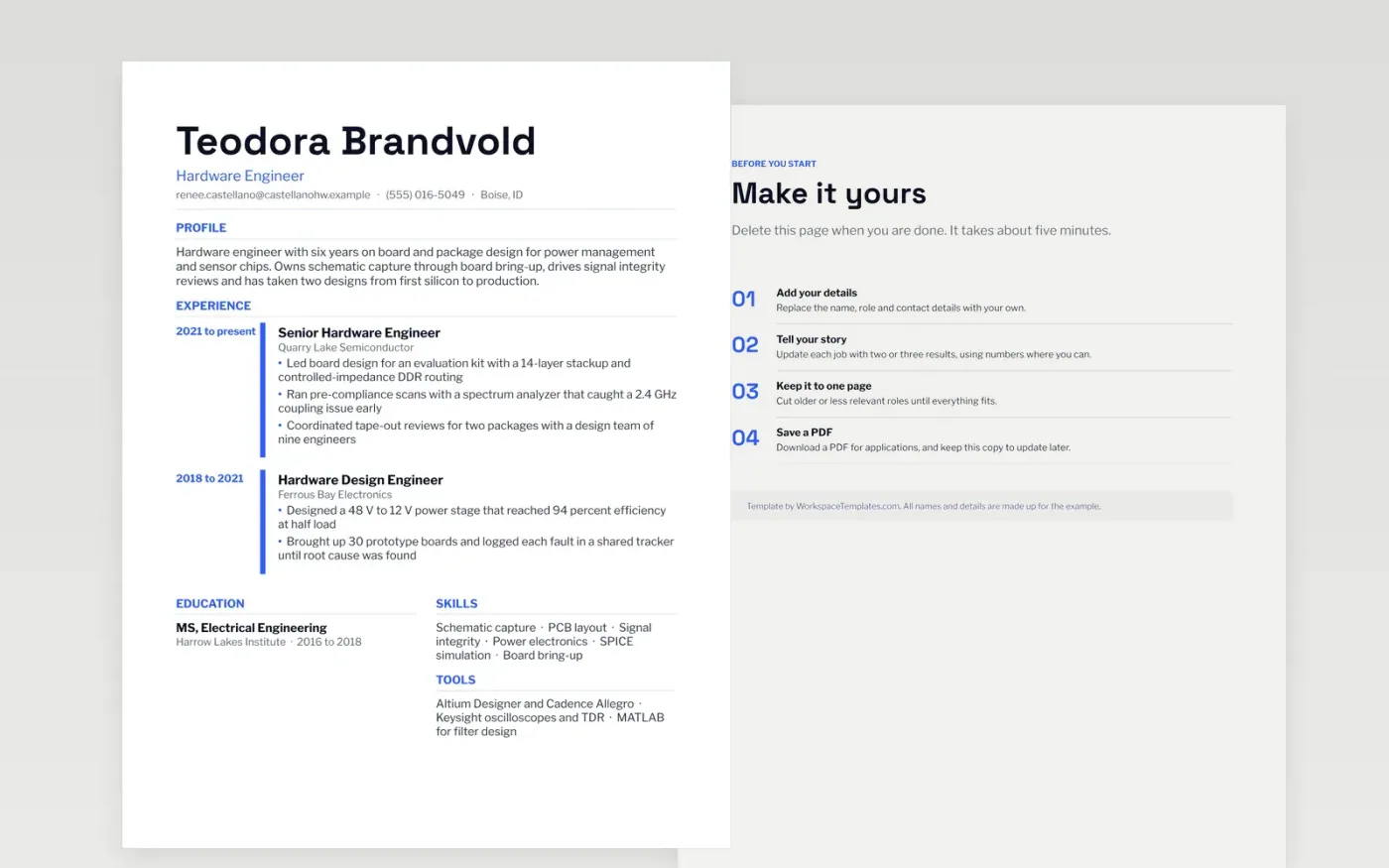
Semiconductor employers want hardware engineers who have carried a board or package from schematic to production. They check for schematic capture and PCB layout tools, signal integrity and power design work, prototype bring-up and participation in tape-out review. Efficiency figures and the number of boards brought up show how much real debugging sits behind a candidate. A timeline arranges each design by date, so one project's progression into the next is easy to trace.
Picture an engineer with six years on power management and sensor chips, who moved from a design role into leading an evaluation kit. Substitute your own employers and numbers. Give each timeline entry one design you owned, its layer count or efficiency result, and the stage it reached. Teams rarely need proprietary part numbers, so describe the chip by what it does.
Make a copy in Google Docs, or download the Word file.
Type over the sample text with your own details.
Delete the guide page when you are done.
Print it, or save it as a PDF.
Name the design tools you worked in, such as Altium Designer or Cadence Allegro, along with the board types you designed, such as multilayer, RF or high-speed memory boards. Give the layer count, the stackup and any controlled-impedance work. Note the design reviews you led and the boards that reached production. Short tool lists with one project each beat long lists.
Yes, but limit the list to instruments you used for real debugging, such as oscilloscopes, spectrum analyzers, logic analyzers or time domain reflectometers. Name the model family when it matters, for example a Keysight scope for signal integrity work. Tie each instrument to a fault you found or a compliance test you passed.
Keep enough detail to show scope without breaching an NDA. Describe what the chip does, such as a power management IC or a sensor interface, and give the process node only in general terms. Use board counts, pin counts or layer counts in place of part numbers. Check your employer's rules before naming any project, and ask first if unsure.
Docs + Word1 page
Free
Docs + Word1 page
Free
Docs + Word1 page
Free
Docs + Word1 page
Free
Docs + Word1 page
Free
Docs + Word1 page
Free
Docs + Word1 page
Free
Docs + Word1 page
Free
Docs + Word1 page
Free
Docs + Word1 page
Free
Docs + Word1 page
Free
Docs + Word1 page
Free
Docs + Word1 page
Free
Docs + Word1 page
Free
Docs + Word1 page
Free