MLK Day Program
Docs + Word2 pages
Free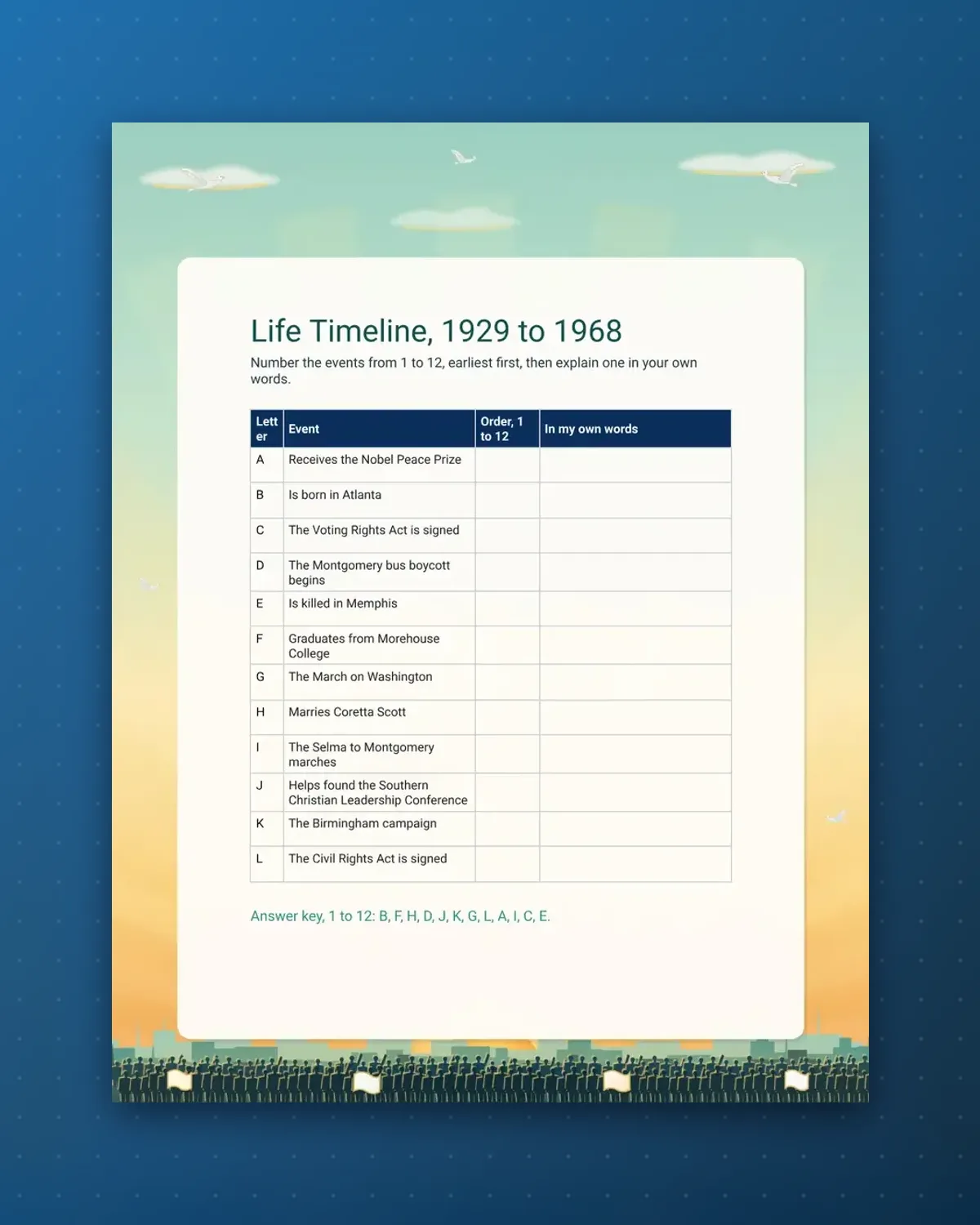
Putting events in order forces students to think about cause and effect. A bus boycott in 1955 leads to a new organization in 1957, the Birmingham campaign and the 1963 March on Washington, and two laws in 1964 and 1965. This sheet lists twelve of those moments, from his birth in 1929 to his death in 1968, mixed up and labeled with letters.
Students number the events, then use the last column to explain one or two in their own words. Years are not printed on the page, so they must use class notes or a book. The answer key is the last line of the page: fold the bottom edge under for a quiz, or leave it showing for a study guide.
Make a copy in Google Docs, or download the Word file.
Type over the sample text with your own details.
Delete the guide page when you are done.
Print it, or save it as a PDF.
The usual anchor points are his birth year, Morehouse in 1948, the bus boycott that began in 1955, the March on Washington in 1963, the Nobel Prize in 1964, the Selma marches of 1965 and his death in 1968.
Hand it out after a reading or video. Have students order the events alone, check with a partner and explain two in a sentence each. Review the key together and talk about what caused each event.
The Civil Rights Act was signed in July 1964, and Dr. King received the Nobel Peace Prize in December 1964. The Selma marches took place in March 1965, followed by the Voting Rights Act in August 1965.
Docs + Word2 pages
Free
Docs + Word1 page
Free
Docs + Word1 page
Free
Docs + Word1 page
Free
Docs + Word1 page
Free
Docs + Word1 page
Free
Docs + Word1 page
Free
Docs + Word1 page
Free
Docs + Word1 page
Free
Docs + Word1 page
Free
Docs + Word1 page
Free