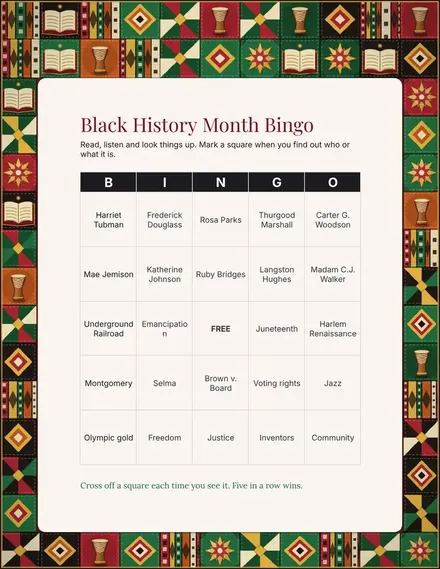
Black History Month Bingo
Docs + Word1 page
Free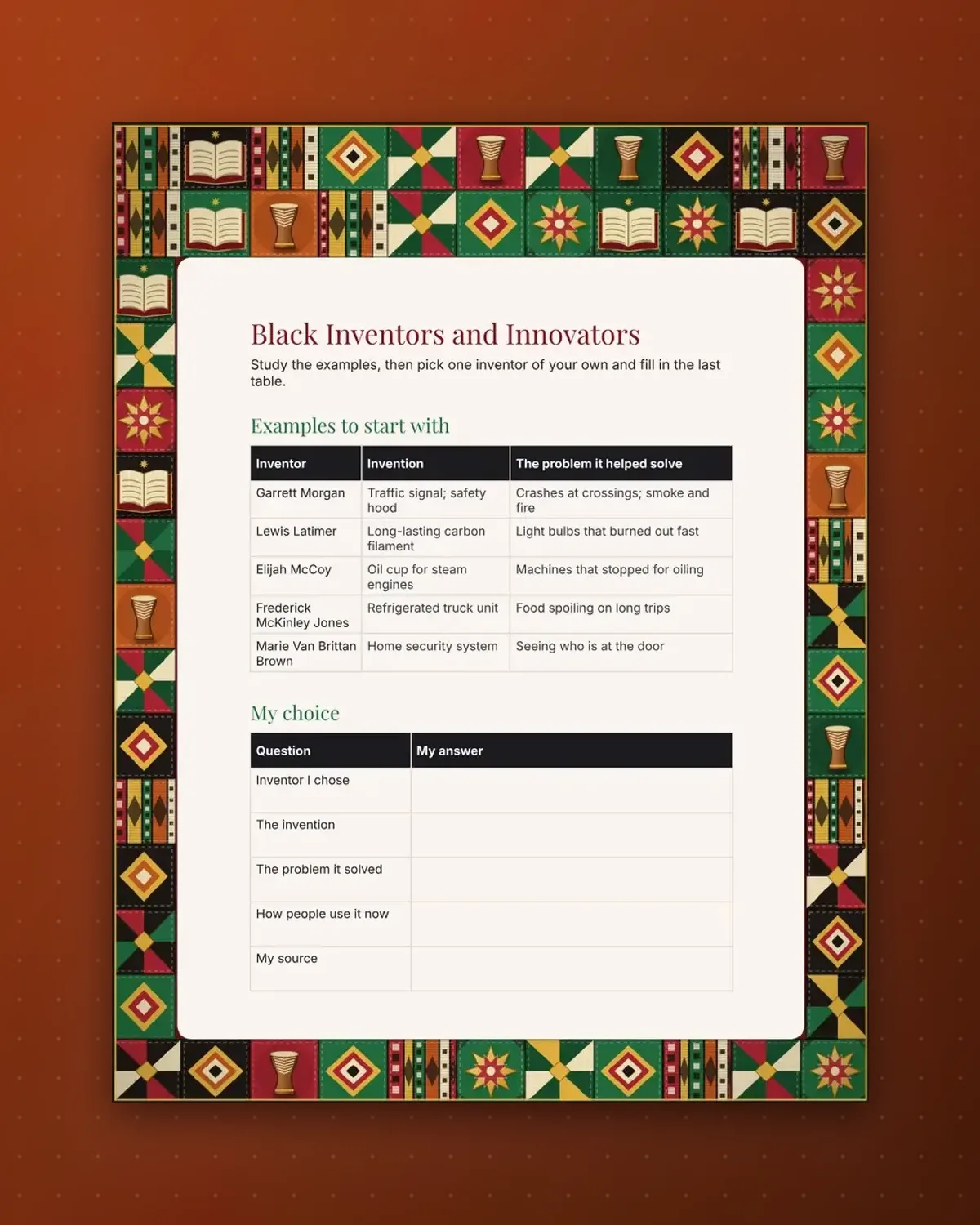
Many students know a few famous names and little about the people who improved everyday things. The first table lists five of them, with an invention and the problem it addressed: a traffic signal, a filament built to burn longer, an oil cup for engines, a refrigerated truck unit and a home security system. These are all documented patents or inventions, so students can look up more in a library.
The second table is left open for any inventor the student picks. They name an inventor, describe the invention and the problem it solved, then explain how people use it today and cite a source. Pair students up to share their discoveries, or ask each to present a one-minute talk. Librarians can stock a cart with biographies and encyclopedias to match.
Make a copy in Google Docs, or download the Word file.
Type over the sample text with your own details.
Delete the guide page when you are done.
Print it, or save it as a PDF.
Start with the five on the sheet, then browse a library biography shelf or a museum website. Many students find a local inventor or an innovator in their own field of interest.
It means the need that came before the invention. For a traffic signal, for example, the need was safer crossings. Asking this question helps students think like inventors.
Yes. Attach a second page for a drawing, or turn one table row into a labeled sketch.
Docs + Word1 page
Free
Docs + Word2 pages
Free
Docs + Word2 pages
Free
Docs + Word1 page
Free
Docs + Word1 page
Free
Docs + Word1 page
Free
Docs + Word1 page
Free
Docs + Word1 page
Free
Docs + Word1 page
Free
Docs + Word1 page
Free
Docs + Word1 page
Free
Docs + Word1 page
Free